The Real Cost of Weak English: Lost Deals, Blocked Promotions

The Cost of Weak English: Lost Deals and Blocked Careers
Poor English isn’t just inconvenient—it creates measurable revenue loss, rework, and career ceilings. Here’s how it happens and what to do.
Executive Summary
Mexican companies are bleeding value through “good enough” English. Here’s what that looks like in business terms:
- Revenue leakage: Contracts lost during discovery calls, procurement reviews, and negotiations when teams can’t defend value or handle objections confidently
- Delivery risk: Requirements ambiguity, poor escalation, and coordination tax across time zones that extend timelines and increase rework
- Talent retention crisis: High-performing engineers and managers leave for companies that invest in communication capability, or they stagnate because they can’t lead in English
- Bus factor vulnerability: Over-reliance on a few bilingual “heroes” creates single points of failure in client-facing operations
- Hidden coordination costs: Each unclear status update, each meeting that needs translation, each document that requires rewriting multiplies across your entire operation
- Promotion bottlenecks: Brilliant technical minds stuck at senior contributor levels because they can’t present to executives or run cross-functional meetings
- Competitive disadvantage: In nearshoring and global services, communication clarity is product differentiation—weak English makes you interchangeable on price
This isn’t about grammar. This is about profit, risk, and strategic capability.
Table of Contents
- The Hidden P&L Impact
- Project Delays, Quality Risks, and Coordination Tax
- Talent Stuck: Promotion Bottlenecks + Retention Risk
- Why Random Classes Fail (And What Replaces Them)
- The Methodology That Actually Works
- Practical Toolkit
- Frequently Asked Questions
The Hidden P&L Impact
How “Good Enough” English Causes Revenue Leakage
Revenue loss from weak English doesn’t show up as a line item. It appears as deals that “just didn’t close,” proposals that went silent, or contracts where you had to discount 20% to win.
Ask yourself:
- How many deals have you lost after strong technical evaluations?
- When was the last time your team deferred to email during a critical client call?
- Are you discounting proactively because defending premium pricing feels too risky?
Here’s where the money disappears:
Discovery and qualification calls: Your technical lead can explain the architecture but struggles when the U.S. buyer asks, “Why should we pay 30% more than your competitor?” The hesitation—that three-second pause before answering—signals uncertainty. The buyer hears doubt about your own value.
Procurement and security reviews: Enterprise deals require clear, confident responses to compliance questions, security concerns, and integration details. When your team defers to email instead of answering live, procurement sees risk. Risk means they negotiate harder or walk away.
Objection handling: A client pushes back on your timeline estimate. Your PM knows the estimate is correct but can’t articulate the dependencies and tradeoffs clearly under pressure. You end up committing to an unrealistic schedule to avoid the conversation.
Scope discussions: The client adds “one small feature” mid-project. Your account manager senses it’s scope creep but doesn’t have the language to push back diplomatically. You eat the cost.
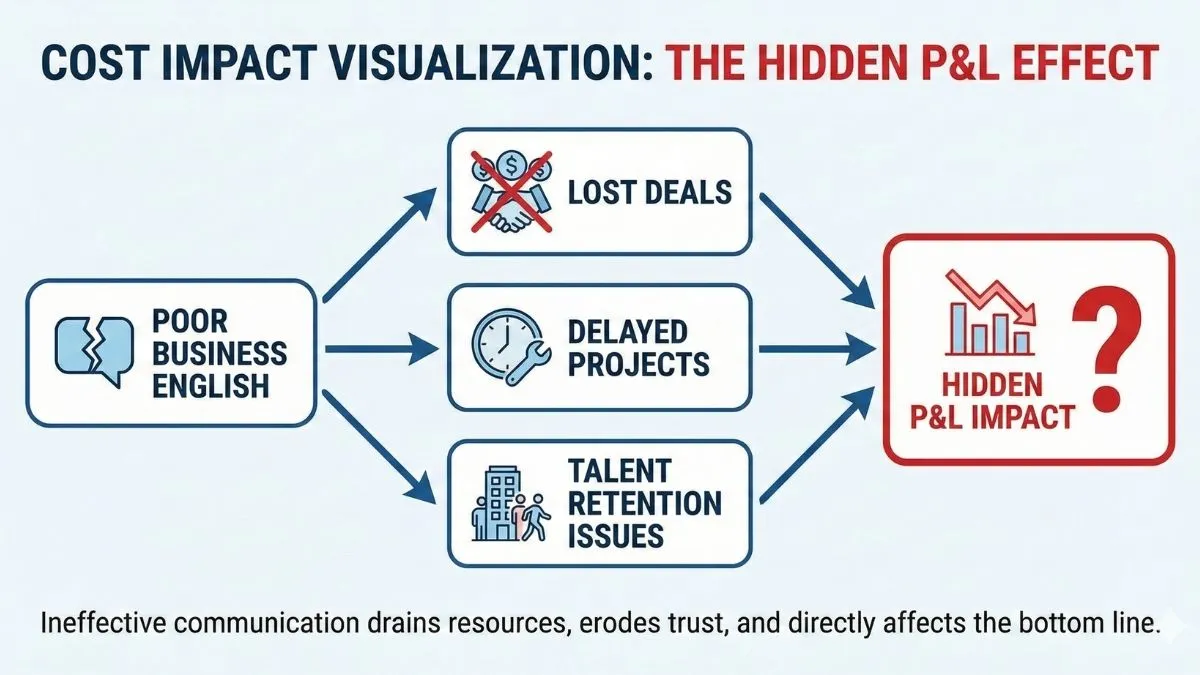
The Hidden P&L Effect: Ineffective communication drains resources, erodes trust, and directly affects the bottom line. Poor business English creates a cascade: lost deals, delayed projects, and talent retention issues that compound into millions in hidden costs.
Three Mexico-Relevant Stories
Story 1: IT Outsourcing Company Loses $180K Contract
The Moment:
A 50-person Guadalajara software house reached the final round for a U.S. fintech company’s year-long engagement. The technical evaluation went well. Then came the executive presentation.
The CTO spoke for 40 minutes. He knew the material cold—architecture decisions, security compliance, delivery model. But his delivery was halting. He translated in his head. He said “How I can say…” twice. He missed the CEO’s question about risk mitigation strategy entirely and had to ask him to repeat it.
The Consequence:
The fintech company chose a slightly more expensive U.S.-based firm. Their feedback: “We need a partner who can communicate with our board directly. We can’t have our CTO translating technical concepts.”
Contract value: $180,000. Lost because of a 40-minute presentation.
What “Better English” Actually Means:
Not vocabulary. Not grammar. The CTO needed:
- Automatic responses under pressure: Pre-built frameworks for common executive questions (risk, ROI, delivery confidence)
- Clear explanation of tradeoffs: The ability to say “Here are three approaches, each with different risk profiles” without mental translation
- Executive presence: Speaking with the calm authority that boards expect, even when stressed
What Would Have Prevented This:
Six weeks of high-pressure executive communication training. Simulated board presentations. Drills on defending technical decisions to non-technical executives. Real-time feedback on clarity and confidence.
Cost of training: ~$3,000. Cost of losing the deal: $180,000.
“Working with Robert has been one of the most impactful steps I’ve taken in advancing my professional communication. As a CTO, his coaching gave me the tools to project true executive presence in English. I’ve learned to structure presentations for impact, handle impromptu speaking under pressure, and lead conversations with clarity and confidence.”
— Luis Manuel Becerra Lucatero, Chief Technology Officer at Skysense
Story 2: Logistics Coordinator Causes $50K in Expedite Fees
The Moment:
A Monterrey-based logistics company manages cross-border shipments for U.S. manufacturers. Their operations coordinator received an urgent call from a Texas client: a critical component shipment was delayed, and they needed clarity on routing options immediately.
The coordinator understood logistics perfectly. But explaining complex routing scenarios in English under time pressure? She froze. She said, “Let me check and send email.” The client needed an answer in 20 minutes, not 4 hours.
The Consequence:
By the time the coordinator sent a detailed (translated) email, the client had already booked an emergency air freight option through another provider. Extra cost: $50,000. The client also started looking at other logistics partners for “faster communication.”
What “Better English” Actually Means:
The coordinator didn’t need business English vocabulary. She needed:
- Real-time problem-solving language: The ability to think through options out loud in English
- Confidence to handle pressure: Not freezing when a client is stressed and demanding immediate answers
- Clear status updates: “Option A costs X with Y risk. Option B costs more but guarantees delivery by Z.”
What Would Have Prevented This:
Scenario-based training. Simulated high-pressure client calls with real logistics problems. Practice explaining routing decisions and cost tradeoffs verbally, not just in writing.
The coordinator wasn’t incompetent. She was undertrained.
Story 3: Startup Founder Discounts 40% to Close First U.S. Deal
The Moment:
A Mexico City SaaS startup reached the negotiation stage with their first major U.S. enterprise customer. The founder-CEO handled the sales process personally. When the client questioned the pricing, the CEO couldn’t clearly articulate the ROI framework or defend the premium positioning.
He felt the negotiation slipping. Rather than risk losing the deal entirely, he offered a 40% discount to close it. The client accepted immediately—a signal that they would have paid more.
The Consequence:
Contract value: $60,000 instead of $100,000. The discount set a precedent. When it came time to renew, the client expected similar pricing.
More damaging: the CEO learned to lead with price, not value. He started discounting proactively in future deals rather than defending his positioning.
What “Better English” Actually Means:
The CEO needed:
- Negotiation frameworks in English: How to reframe pricing objections as investment conversations
- Confidence to hold the line: The language to say “Let me show you why this pricing reflects the value” without sounding defensive
- Objection handling phrases: Automatic responses to common pushback (“Too expensive,” “Your competitor is cheaper,” “We need more features”)
What Would Have Prevented This:
Negotiation simulations. Role-playing aggressive buyers. Practice defending value under pressure until the right phrases became automatic.
Training cost: ~$5,000. Cost of the unnecessary discount: $40,000 in year one, plus the long-term anchor effect on pricing.
“Being a founder means constantly pitching, persuading, and leading. Robert’s coaching gave me the language tools—and the confidence—to do it all in English. It’s made a real difference in pitching deals and connecting with my team.”
— Hugo Blum, CEO at 100 Ladrillos
The Pattern
Notice what these stories have in common:
- Technical competence wasn’t the issue. These people knew their domains.
- The failure happened under pressure. In executive-level situations with time pressure, language ability collapsed.
- The cost was immediate and measurable. Not “soft” skills issues—actual P&L impact.
- Prevention was straightforward and affordable. Focused training would have paid for itself many times over.
“Good enough” English works fine in low-pressure situations. It fails exactly when it matters most.
Ready to prevent these losses in your organization?
Book a free 30-minute strategy call →
Project Delays, Quality Risks, and Coordination Tax
How English Gaps Create Operational Drag
Revenue loss is visible. Coordination tax is insidious—it compounds daily across your entire operation.
Does this sound familiar?
- Status updates take 30 minutes to write that should take 5 minutes
- Simple clarifications require overnight email cycles instead of 2-minute Slack conversations
- Your bilingual PM is the bottleneck for all client communication
Requirements Ambiguity
A U.S. product manager writes: “We need this feature to be intuitive for non-technical users.”
Your development team reads “intuitive” and interprets it as “simple UI.” They build a streamlined interface with minimal options.
The PM expected “guided workflow with contextual help.” Three weeks of work need to be redone.
The real cost: Not just the rework. It’s the schedule delay, the demoralized team, the client frustration, and the damaged credibility. One ambiguous word—“intuitive”—cost you three weeks because no one felt confident enough to ask clarifying questions in English.
Poor Escalation and Risk Reporting
Your technical lead discovers a major integration problem that will delay delivery by two weeks. He knows he needs to tell the client immediately.
But explaining technical blockers in English—especially when delivering bad news—is hard. He spends four hours crafting a careful email. By the time it reaches the client, they’re already angry about the silence.
The coordination tax: Every delayed escalation extends the impact. Every risk that isn’t communicated clearly becomes a crisis. Every status update that requires translation adds friction.
Multiply this across your team. If five people each lose 30 minutes a day to communication struggles, that’s 2.5 hours of daily coordination tax. Over a year: 600+ hours of lost productivity.
Misalignment Across Time Zones
Your Mexico City team finishes their day at 6 PM. The U.S. client reviews deliverables at 10 AM Pacific (noon Mexico time) and has questions.
If your team can respond clearly and confidently in real-time Slack conversations, issues get resolved in minutes. If they need to carefully compose responses or wait for bilingual team members, simple questions turn into overnight delays.
One clarification delay = 18-24 hour cycle time. On a six-month project, poor real-time communication can add weeks to the timeline.
Over-Reliance on Bilingual “Heroes”
You have two or three people who are truly fluent in English. They become the gatekeepers for all client-facing communication.
The bus factor: What happens when your bilingual PM is on vacation? Or leaves the company? Your entire client relationship depends on these few people.
The retention risk: These bilingual team members know they’re indispensable. They get recruited aggressively. When they leave, they take institutional knowledge and client relationships with them.
The equity problem: Less bilingual team members—even if equally talented—get passed over for leadership opportunities because they “can’t handle client calls.”
This creates a two-tier system. The bilingual rise. The rest stay stuck.

The Reality of Global Business: Many high-value opportunities explicitly require fluent English communication. When your team can’t meet this standard, you’re locked out of premium contracts and forced to compete on price alone.
The Coordination Tax Framework
Calculate your real cost:
Formula: (People affected) × (Minutes lost per day) × (Loaded hourly rate) × (Working days) × (Project risk multiplier)
Example for a 20-person team:
- 10 people struggle with English communication
- 30 minutes lost daily on average (translation, clarification, rewrites)
- $50/hour loaded cost
- 240 working days/year
- 1.5x risk multiplier (schedule delays, rework, client friction)
Cost = 10 × 0.5 hours × $50 × 240 × 1.5 = $90,000/year
That’s conservative. It doesn’t include:
- Lost deals
- Client churn from poor communication
- Team member turnover
- Opportunity cost of work that didn’t happen because people were stuck in translation mode
For a 100-person company, the coordination tax can easily reach $500,000 annually.
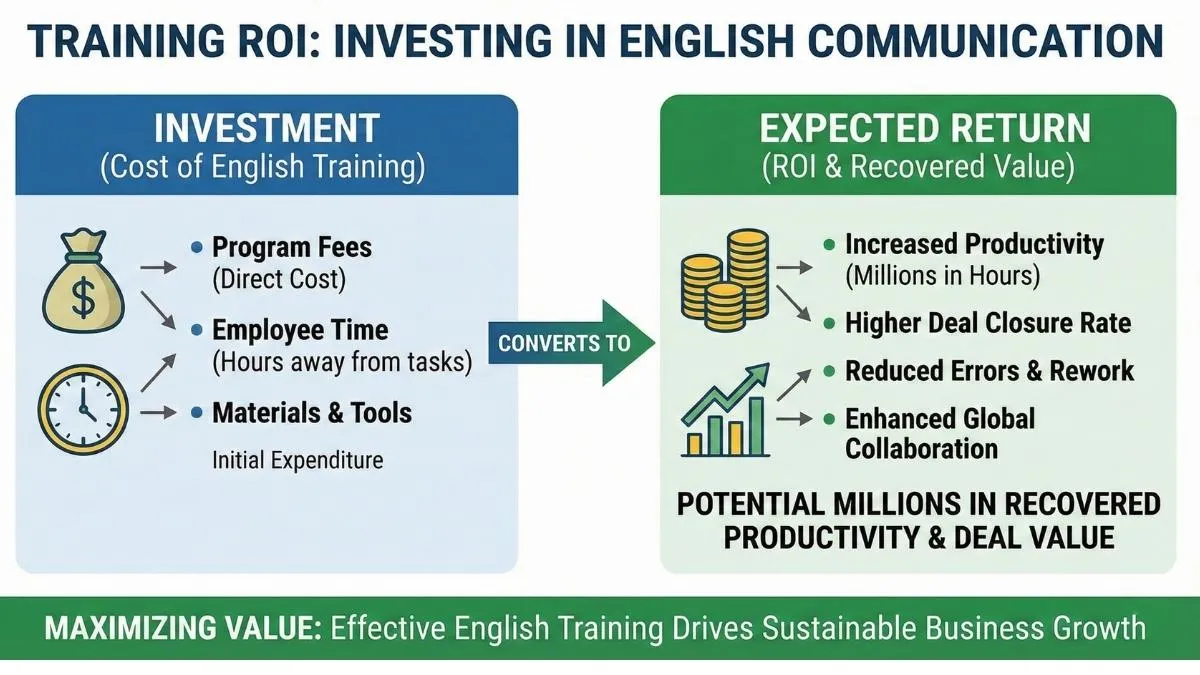
Training ROI: Investing in English Communication
The investment (program fees, employee time, materials) converts directly to millions in recovered productivity and deal value through:
- Increased productivity (millions in recovered hours)
- Higher deal closure rates
- Reduced errors and rework
- Enhanced global collaboration
Bottom line: Effective English training drives sustainable business growth.
Simple ROI Estimator (Example)
Let’s say you invest in systematic English training:
Investment:
- 40 people × $5,000/person = $200,000
- Structured program over 6 months
- Focused on business communication, not grammar
Expected reduction in coordination tax: 50% (conservative)
Expected improvement in deal close rates: 15% (modest)
Expected reduction in scope disputes: 25%
Year-one return (coordination tax alone): $45,000 × 40 people = $1.8M in recovered productivity
Additional revenue from improved close rates: If you pursue $2M in opportunities, a 15% improvement = $300K in additional revenue
Total first-year impact: $2.1M Investment: $200K ROI: 10.5x
These aren’t guarantees. But they illustrate why treating English as a strategic investment—not a “nice to have”—makes financial sense.
Want to calculate your specific coordination tax?
Schedule a free ROI assessment call →
Talent Stuck: Promotion Bottlenecks + Retention Risk
The Career Ceiling
Your senior backend developer is brilliant. She designs elegant systems, mentors junior developers, and consistently delivers on time.
But she can’t lead a cross-functional planning meeting in English. She avoids client-facing technical reviews. When executives ask her questions, she defers to her manager.
Result: She doesn’t get promoted to architect or engineering lead. Not because she lacks technical judgment. Because she can’t communicate that judgment in English.
Is this happening on your team right now?
The Promotion Filter
Leadership roles require:
- Running meetings: Facilitating discussions, managing conflict, driving decisions
- Executive updates: Explaining technical tradeoffs to non-technical stakeholders
- Cross-functional collaboration: Aligning product, sales, and engineering in real-time
- Client-facing representation: Defending architectural decisions, handling escalations
“Good enough” English isn’t sufficient for any of these. You need to think on your feet, read the room, adjust your message dynamically, and project confidence—all in English.
Companies end up promoting people who are “good enough technically” and “strong in English” over people who are “excellent technically” and “weak in English.”
This isn’t a fair system. But it’s the reality.
“The main challenge I faced when I started working in global environments was the lack of fluency to express my technical ideas effectively. Robert has been coaching me, and we’ve practiced various scenarios together. Now I feel much more fluent and confident. I’ve been able to mobilize multinational teams and align them around strategies that make sense for everyone.”
— Jonathan Emmaus Campos Navarro, Data Lead at Infosys
Read more stories from engineers who broke through the ceiling →
Retention Impact
Your best people notice this pattern. They realize their career progress is capped by language, not capability.
Three things happen:
- They leave for companies that invest in English training. Global tech companies and multinational consulting firms budget heavily for communication development. Your top talent goes there.
- They leave for fully Spanish-speaking roles. Instead of growing into leadership at your company, they take slightly lower-paying roles at local firms where language isn’t a barrier.
- They disengage. They stop pursuing stretch projects, stop volunteering for client-facing work, and mentally check out. You lose their discretionary effort.
The cost: Replacing a senior engineer costs 1.5–2x their annual salary (recruiting, ramping, lost productivity). If weak English causes you to lose even two high performers per year, that’s $200K–300K in turnover costs.
English as an Inclusion Issue
This isn’t just about individuals. It’s about systemic equity.
When English becomes the de facto filter for advancement, you create a two-tier organization:
- Tier 1: Bilingual employees who get visibility, client exposure, and leadership opportunities
- Tier 2: Everyone else, regardless of technical excellence
This concentration of power is risky. Decision-making quality suffers when only a small subset of your talent pool can participate in strategic conversations.
It’s also a morale problem. High-performing engineers who feel locked out of leadership don’t stay motivated for long.
The Manager’s Dilemma
You’re a Mexican engineering manager. You have five direct reports:
- Two are bilingual. They handle client calls, lead technical reviews, and represent the team in cross-functional meetings.
- Three are less fluent. They’re excellent developers but struggle with verbal communication in English.
When a leadership opportunity opens, who do you promote?
You want to promote based on technical merit. But you also need someone who can operate independently with U.S. stakeholders. You end up choosing from the bilingual pool, even if the technical difference isn’t that large.
The stuck developers see this. They know they’re passed over because of language. If you don’t invest in closing that gap, they’ll eventually leave.
What “Promotion-Ready English” Looks Like
It’s not about grammar. It’s about:
Running effective meetings in English:
- “Let’s start with the biggest blocker.”
- “I hear two different perspectives—let me make sure I understand both.”
- “We need to make a decision today. Here are the tradeoffs.”
Explaining technical concepts to non-technical people:
- “Think of it like a restaurant kitchen. We can serve more customers if we hire more cooks, but only if the kitchen space can handle them. That’s our scalability constraint.”
Handling conflict diplomatically:
- “I understand the urgency, but this approach creates technical debt. Let me show you the long-term cost.”
Projecting executive presence:
- Speaking at an even pace, with clear structure, and without hedging (“maybe,” “I think,” “possibly”)
- Making eye contact, using confident body language, and owning the message
These are skills. They can be trained. But random English classes don’t teach them.
Ready to build your leadership pipeline?
Learn about our executive English coaching programs →
Why Random Classes Fail (And What Replaces Them)
The Difference Between Activity and Strategy
Most companies approach English training as an HR checkbox:
- Sign up for a corporate English course
- Employees attend weekly classes
- Focus on grammar, vocabulary, generic business topics
- No connection to actual work scenarios
- No measurement of business outcomes
Result: Marginal improvement in test scores. No change in business performance.
Classes create activity. They don’t create capability.
Sound familiar?
What Global Companies Do Differently: Language Strategy
Companies like Google, McKinsey, and HSBC don’t treat language as an HR perk. They treat it as a strategic capability that enables global operations.
They apply language strategy thinking:
- Define business outcomes first: What communication tasks actually matter for revenue, delivery, and leadership?
- Map roles to required communication skills: A sales engineer needs different English than a backend developer.
- Build targeted training around high-frequency scenarios: Practice the exact conversations that happen weekly.
- Measure impact on business metrics: Close rates, cycle time, client satisfaction, promotion rates—not just test scores.
- Integrate training with work: Don’t separate “learning English” from “doing the job.” Build communication practice into daily workflows.
This isn’t expensive. It’s disciplined.
The 1-Page Language Strategy Playbook
Here’s how to build a language strategy for your company:
Step 1: Define Business Outcomes
Ask: Where does weak English hurt us?
- Sales and client acquisition?
- Project delivery and coordination?
- Leadership pipeline and retention?
Pick the top two. Focus there first.
Step 2: Identify Critical Communication Scenarios
List the 10–15 English conversations that happen repeatedly and matter most.
Examples for IT services:
- Discovery calls with prospective clients
- Technical architecture presentations
- Sprint planning with distributed teams
- Escalation calls when projects have issues
- Status updates to C-level stakeholders
- Scope negotiation discussions
- Code review comments and feedback
- Retrospective facilitation
- Conflict mediation between teams
- Job interview technical evaluations
If you improve these 10–15 scenarios, you improve outcomes.
Step 3: Map Roles → Required Speaking Tasks
Not everyone needs the same English skills.
Sales engineers need:
- Discovery questioning
- Objection handling
- Proposal defense
- ROI articulation
Project managers need:
- Status updates under pressure
- Risk escalation
- Scope boundary setting
- Cross-functional coordination
Senior developers need:
- Architectural explanations
- Code review feedback
- Technical tradeoff discussions
- Mentoring and teaching
Train people for the scenarios they face, not generic business English.
Step 4: Build Measurement into the System
Track business metrics:
- Sales: Win rates on deals involving verbal presentations
- Delivery: Cycle time for decision-making, frequency of rework due to miscommunication
- Retention: Promotion rates for non-bilingual employees, turnover rates by English proficiency
- Client satisfaction: Net Promoter Score (NPS), communication clarity ratings
If training doesn’t move these metrics, adjust the approach.
Step 5: Design Training as a System, Not a Class
A system includes:
- Foundations: Fix high-frequency pronunciation and grammar errors that block credibility
- Scenario drills: Practice the top 10–15 critical conversations repeatedly
- Simulations: Role-play high-pressure moments (conflict, objections, bad news)
- Real-time feedback: Record sessions, review, correct, repeat
- Accountability: Tie participation to performance reviews and promotion criteria
This isn’t a weekly class. It’s structured practice integrated into work.
Want help designing your language strategy?
Schedule a free consultation →
The Methodology That Actually Works
A System, Not a Course
Here’s the training methodology that produces measurable business results. This isn’t theory—it’s how you build communication capability that survives pressure.
“I am pleased to recommend Robert as an exceptional language teacher and executive-communication coach. Under his guidance, I moved from feeling hesitant in senior-level discussions to speaking with assurance in top-management meetings and presenting complex updates with clarity and persuasion.”
— Hugo Lopez, Testing & EPM Manager at Continental
1) Student Profile → Custom Content
Start with a detailed profile:
- Current English level (not A1/B2 labels—actual speaking performance)
- Role and responsibilities
- Specific objectives (close more deals, lead meetings, handle escalations)
- High-frequency scenarios they face weekly
Use AI to generate custom materials:
Why this matters now: historically, custom training was expensive because it required human effort to tailor content. AI enables scalable personalization.
For a sales engineer, generate practice dialogues around discovery calls and objection handling. For a project manager, generate status update scenarios and risk escalation scripts.
Each student gets relevant practice, not generic lessons.
2) “Hard-Code Foundations” Drills
Weak pronunciation and high-frequency grammar errors destroy credibility under pressure.
Focus on the errors that matter most:
- -ed endings: “We developed a solution” not “We develop a solution” (past tense clarity)
- Th-sounds: “Three things” not “Tree tings”
- Word stress: “DEvelop a SOlution” not “DEVelop a soLUtion”
- Verb tense consistency: Switching between past and present mid-sentence signals uncertainty
Why foundations matter:
When you’re nervous—during a tense negotiation or an executive presentation—you revert to automatic patterns. If your automatic patterns include distracting errors, your message gets lost.
Fix the top 10 recurring errors through repetition drills. Make correct pronunciation and grammar automatic so you don’t have to think about it under pressure.
3) Vocabulary → Chunks and Collocations
Don’t memorize individual words. Learn high-frequency phrases.
Collocations (words that naturally go together):
- “reach a decision” not “arrive at a decision”
- “meet a deadline” not “achieve a deadline”
- “raise a concern” not “lift a concern”
Phrasal verbs:
- “Circle back on that”
- “Push back on the timeline”
- “Flag this as a risk”
Framework phrases:
- “Let me walk you through three options.”
- “The tradeoff here is X versus Y.”
- “To clarify, are you asking about A or B?”
Scenario-specific phrases:
- Starting a story: “Let me give you some context.” / “Here’s what happened.”
- Status updates: “We’re on track for X. The blocker is Y. We’ll resolve it by Z.”
- Handling objections: “I understand your concern. Let me address that directly.”
Build a personal phrase bank for the situations you face repeatedly. Practice these until they’re automatic.
4) Executive Communication + Personal Brand
Language affects perceived leadership presence.
Self-awareness:
- Do you sound confident or uncertain?
- Do you hedge unnecessarily? (“Maybe,” “I think,” “Kind of”)
- Do you speak too fast when nervous?
- Do you make eye contact or look down?
Confidence under scrutiny:
- Answering questions clearly without over-explaining
- Saying “I don’t know, but I’ll find out” instead of guessing
- Handling pushback without getting defensive
Professional identity in English:
How do you want to be perceived? As the expert? The problem-solver? The strategic thinker?
Your language choices signal your identity. Train to match the persona you want to project.
Example:
- Weak: “Um, yeah, I think we could maybe try to do it that way, if that works for everyone.”
- Strong: “Yes, that approach is feasible. Here’s what we’ll need to make it work.”
The content is similar. The perception is completely different.
“Before working with Robert, I sometimes felt unsure presenting in English during executive-level calls and real-time meetings with international customers. His coaching has helped me build greater confidence in speaking, expand my vocabulary, and give structure to my ideas. Now, I feel more secure and fluent in my communication and I perform better in technical discussions and negotiations.”
— Tania Ruelas, Quality Key Account Manager at FORVIA HELLA
5) High-Pressure Simulations
This is where the system earns its ROI.
Simulate real stress:
- Time pressure: “You have two minutes to convince me.”
- Conflict: “Your solution won’t work. Defend it.”
- Bad news delivery: “Tell the client we missed the deadline.”
- Executive questioning: “Why are we paying you 30% more than your competitor?”
Why pressure matters:
In comfortable classroom environments, most people can communicate adequately. But in executive-level situations—a big deal, an angry client, an executive review—stress collapses language ability.
You revert to what’s automatic. If you’ve never practiced high-pressure scenarios, you’ll freeze or fumble.
The training structure:
- Drill the scenario: Practice the same high-pressure conversation 5–10 times
- Record and review: Watch yourself, identify weaknesses
- Get real-time feedback: “You hesitated here. Your tone signaled doubt. Try again.”
- Repeat until automatic: The goal is to respond confidently without thinking
By the 10th repetition, the right phrases and tone become second nature. When the real situation happens, you’re ready.
Why This Approach Works
Traditional classes teach knowledge: grammar rules, vocabulary lists, generic dialogues.
This system trains performance: the ability to execute critical communication tasks under real-world conditions.
The difference:
- Knowledge: “I know the correct way to phrase a status update.”
- Performance: “When the client asks me a tough question, I respond clearly and confidently without hesitation.”
Knowledge is necessary. Performance is what drives business outcomes.
Ready to see how this works for your team?
Book a free strategy session →
Practical Toolkit
Diagnostic Checklist: Is English Costing You Money?
Answer honestly. If more than 5 of these are true, weak English is directly affecting your bottom line.
Revenue & Client Acquisition:
- We lose deals after strong technical evaluations but weak presentations
- Our team defers to email during critical live client discussions
- We discount proactively to avoid defending our pricing in English
- Clients complain that communication is “slower than expected”
- We avoid pursuing enterprise deals because of communication concerns
Project Delivery:
- Requirements clarification cycles add 1–2 weeks to most projects
- Status updates require translation or significant preparation time
- Escalations are delayed because team members struggle to articulate risks
- We have frequent rework due to misunderstood client feedback
- Cross-functional alignment takes multiple meetings to achieve
Team & Leadership:
- Our best technical people can’t advance because of language barriers
- We rely on 2–3 bilingual “heroes” for all client-facing work
- High performers leave for companies with better English training
- Promotion decisions favor “good enough technically + strong English” over “excellent technically + weak English”
- Team members avoid volunteering for visible projects due to language anxiety
If you checked 5+: English gaps are costing you measurable revenue and productivity. If you checked 10+: This is a strategic emergency.
Get a personalized assessment:
Schedule your free ROI diagnostic call →
Manager’s Quick-Fix: 30-Day Action Plan
You can’t solve this overnight. But you can start seeing improvement in 30 days with focused action.
Week 1: Diagnose
- List your top 10 recurring English conversations (sales calls, status updates, escalations, etc.)
- Identify the 5 people most affected by weak English
- Estimate your monthly coordination tax (use the framework from Section B)
Week 2: Build a Phrase Bank
- Record 3–5 actual work conversations (with permission)
- Extract the phrases that worked well
- Identify the moments where communication broke down
- Create a shared document with “phrases that work” for common scenarios
Example structure:
- Starting a status update: “Here’s where we are. [Current state]. The blocker is [X]. We’ll resolve it by [date].”
- Pushing back on scope: “I want to make sure we deliver quality. Adding this now would compromise [timeline/quality]. Can we schedule it for phase 2?”
- Clarifying requirements: “To make sure I understand: are you asking for [A] or [B]?”
Week 3: Practice Drills
- Pick one high-frequency scenario (e.g., status updates)
- Run 10-minute practice sessions daily with team members
- Simulate pressure: Set a timer, add fake urgency
- Record and review
Focus on one scenario until it feels automatic.
Week 4: Apply and Measure
- Use the new phrases in real situations
- Track outcomes: Did communication improve? Did it save time?
- Adjust the phrase bank based on what worked
After 30 days, you’ll have:
- A documented phrase bank for your team
- Measurable improvement in one critical scenario
- Data to justify investing in systematic training
Meeting Scripts / Templates
These are realistic templates for high-frequency business scenarios. Customize them for your context.
Template 1: Status Update to U.S. Stakeholders
Structure:
“Good morning, everyone. Let me give you a quick update on [project name].
Current status: [On track / Slightly behind / Ahead of schedule].
What we completed this week: [2–3 key achievements].
What’s next: [1–2 upcoming milestones].
Blockers: [If any]. We’re addressing this by [action + timeline].
Questions or concerns?”
Why this works:
- Starts with clarity (on track or not)
- Highlights progress (builds confidence)
- Names blockers proactively (shows ownership)
- Ends with engagement (invites questions)
Template 2: Raising a Risk Without Sounding Weak
Structure:
“I need to flag a risk.
The issue: [Clear description of the problem].
The impact if we don’t address it: [Business consequence—delay, cost, quality].
What I recommend: [Proposed solution].
What I need from you: [Decision, resources, approval].
Timeline: We need to decide by [date] to avoid [consequence].”
Why this works:
- Frames it as “risk management,” not “I screwed up”
- Focuses on impact (helps stakeholders prioritize)
- Offers a solution (shows leadership)
- Asks for specific support (not vague “help”)
Template 3: Pushing Back on Scope Creep
Structure:
“I want to make sure we’re aligned on scope.
What we agreed to: [Original scope, briefly].
What you’re asking for: [New request].
Here’s the tradeoff: [Impact on timeline/budget/quality].
My recommendation: [Option 1: Add to phase 2. Option 2: Deprioritize something else. Option 3: Accept the delay/cost].
What works best for your priorities?”
Why this works:
- Doesn’t say “no”—frames it as a tradeoff
- Acknowledges the request (shows listening)
- Provides options (gives client control)
- Forces explicit prioritization (prevents implied agreement)
Template 4: Defending an Architectural Decision
Structure:
“Let me explain why we chose this approach.
Your concern: [Restate the objection].
Why we decided this way: [1–2 key reasons].
The alternative you’re suggesting: [Acknowledge it]. Here’s why we didn’t go that route: [Tradeoffs].
If you’d like to revisit this, here’s what it would require: [Cost, timeline, risk].
**But our recommendation remains [original decision] because [core reason].”
Why this works:
- Shows you heard the objection
- Explains reasoning clearly
- Acknowledges alternatives (shows you considered them)
- Stays confident without being defensive
Template 5: Handling a Client Objection
Structure:
“I understand your concern. Let me address that.
Your concern: [Restate it accurately].
Here’s why that’s not a problem: [Clear explanation].
What other clients have found: [Social proof, if applicable].
How we ensure this works for you: [Specific mechanism or guarantee].
Does that address your concern, or is there something else we should discuss?”
Why this works:
- Validates the concern (doesn’t dismiss it)
- Addresses it directly (no hedging)
- Provides evidence (reduces doubt)
- Checks for hidden objections (prevents surprises)
Want personalized templates for your specific scenarios?
Get custom communication frameworks →
Frequently Asked Questions
1. How long does it take to see business results from English training?
Quick wins (30–60 days):
- Improved confidence in status updates and routine client interactions
- Faster response times (less translation/rewriting)
- Fewer clarification cycles on common tasks
Measurable business impact (90–180 days):
- Higher deal close rates
- Reduced project cycle time
- Improved client satisfaction scores
- First promotions for previously-stuck team members
Sustained strategic outcomes (6–12 months):
- Reduced reliance on bilingual gatekeepers
- Lower coordination tax across the organization
- Stronger leadership pipeline
- Improved talent retention
The timeline depends on starting proficiency and intensity of training.
2. What’s the difference between this and standard corporate English classes?
Standard classes:
- Generic business vocabulary
- Grammar-focused
- Classroom-based learning
- No connection to real work scenarios
- No measurement of business outcomes
Strategic language capability training:
- Role-specific communication scenarios
- Performance-focused (not knowledge-focused)
- Integrated with actual work
- High-pressure simulations
- Measured by business metrics (close rates, cycle time, retention)
One is an HR program. The other is a strategic capability investment.
3. Isn’t English training expensive?
Compare costs:
- Coordination tax for a 50-person team: ~$250,000/year
- Cost of losing one major deal due to weak presentation: $100,000–500,000
- Cost of losing two high performers per year: $200,000–400,000 in turnover
Typical training investment:
- $3,000–7,000 per person for a structured 6-month program
ROI: If training improves deal close rates by 10%, reduces coordination tax by 30%, and prevents one key departure, you’re looking at 5–10x return in year one.
The real question: Can you afford NOT to invest?
4. Can’t people just learn on their own?
Some can. Most won’t.
Why self-study fails:
- No accountability
- No feedback on speaking performance
- No practice under pressure
- No connection to real work scenarios
- Easy to deprioritize when work gets busy
Self-study works for motivated individuals learning at their own pace. It doesn’t scale across an organization.
Structured training with clear business objectives, regular practice, and measurement drives results.
5. What if we’re a fully remote team—does this still apply?
Yes—even more so.
Remote work increases the communication burden. You can’t rely on hallway conversations, body language, or quick check-ins.
Everything is verbal or written English:
- Video calls
- Slack/Teams messages
- Documentation
- Presentations
If your team struggles with English, remote work amplifies the problem.
6. How do we measure success?
Track business metrics, not test scores:
Revenue:
- Win rate on deals involving verbal presentations
- Average deal size
- Discount frequency
- Time to close
Delivery:
- Cycle time for key decisions
- Frequency of requirements clarification
- Rework rates
- Client satisfaction (NPS)
Talent:
- Promotion rates for non-bilingual employees
- Voluntary turnover rates
- Internal mobility
- Employee satisfaction with career development
Pick 3–5 metrics that matter most to your business. Track them monthly.
7. What about employees who resist English training?
Common objections:
- “I don’t need it—I’m technical, not sales.”
- “I’m too busy.”
- “I’m too old to improve.”
How to address:
Tie it to career progression:
- Make English capability a factor in promotion criteria
- Show clear examples of people who advanced after improving communication
Connect it to autonomy:
- “Better English means you can lead projects independently, not always wait for the bilingual PM.”
Start with visible wins:
- Train a pilot group first
- Showcase measurable improvements (faster responses, better client feedback, promotions)
- Use success stories to motivate others
Make it a system, not optional:
- Integrate practice into weekly routines
- Provide accountability (check-ins, peer practice)
- Recognize and reward improvement publicly
Resistance drops when people see real career and business benefits.
8. How is nearshoring changing English requirements?
The nearshoring opportunity:
Mexico is winning software development, manufacturing, and logistics contracts because of proximity, time zone alignment, and cost advantages.
But the competition is increasing:
- Eastern Europe (Poland, Romania, Ukraine)
- Latin America (Argentina, Colombia, Brazil)
- Asia (India, Philippines)
The differentiator:
Not just technical skill. Communication clarity.
U.S. companies want partners who can:
- Understand requirements without constant clarification
- Provide proactive updates
- Handle conflicts diplomatically
- Represent themselves confidently in executive meetings
If your team can do this, you command premium pricing. If not, you compete on cost.
English capability is becoming a competitive advantage in nearshoring, not just a requirement.
Learn how nearshoring leaders are winning with communication →
9. Should we focus on speaking or writing?
Both matter. But speaking is higher-leverage.
Why speaking comes first:
- Deals are won or lost in live conversations
- Project decisions happen in meetings
- Leadership is demonstrated through verbal communication
- Speaking under pressure is harder to fake than writing
Writing can be edited. You can use tools, ask for reviews, take time.
Speaking is real-time. You need automatic, confident responses.
Focus 70% of training on speaking scenarios. 30% on writing for clarity.
10. What about accent reduction?
Accent matters less than clarity.
U.S. clients work with international teams all the time. They’re used to accents.
What causes problems:
- Mumbling or speaking too fast
- Pronunciation errors that obscure meaning (“sheet” vs. “seat”)
- Inconsistent word stress that makes sentences hard to follow
What doesn’t cause problems:
- A Mexican accent, as long as pronunciation is clear
Focus on:
- Clear enunciation
- Appropriate pace
- Correct word stress
- Fixing specific pronunciation errors that block understanding
Don’t aim for a perfect American accent. Aim for confident, clear communication.
11. How do we choose a training provider?
Look for these qualities:
✓ Business-focused curriculum: Training tied to real work scenarios, not generic lessons ✓ Performance measurement: Track business outcomes, not just test scores ✓ Customization: Tailored content by role and industry ✓ High-pressure practice: Simulations, role-plays, real-time feedback ✓ Scalability: Can handle 20–100+ employees without diluting quality ✓ Accountability systems: Regular check-ins, practice tracking, peer accountability
Red flags:
✗ Generic corporate English classes ✗ Focus on grammar and vocabulary, not speaking performance ✗ No connection to your specific business scenarios ✗ No measurement of business impact ✗ One-size-fits-all curriculum
Ask potential providers:
- “How do you measure success for our business?”
- “Can you show examples of role-specific training?”
- “What’s your approach to high-pressure scenarios?”
Choose partners who understand your business goals, not just English education.
12. Can AI replace human English coaches?
AI is a powerful tool for practice and feedback. But it doesn’t replace human coaching.
What AI does well:
- Generate custom practice scenarios
- Provide instant feedback on pronunciation and grammar
- Scale practice opportunities (24/7 availability)
- Track progress over time
What AI can’t do (yet):
- Read emotional nuance and adjust coaching in real-time
- Provide strategic feedback on executive presence
- Simulate authentic high-pressure human dynamics
- Build accountability and motivation
Best approach: Blend AI-powered practice with human coaching for critical skills.
Conclusion: Treat English as a Strategic Capability, Not an HR Perk
If you’ve read this far, you already know weak English is costing you.
Lost deals. Delayed projects. Stuck talent. Coordination drag.
The question isn’t whether to fix it. The question is how systematically you’re willing to invest.
Three options:
- Do nothing. Keep bleeding revenue, losing people, and relying on bilingual gatekeepers. Hope the problem solves itself.
- Generic training. Sign up for corporate classes, check the HR box, see minimal results, wonder why nothing changed.
- Strategic investment. Build a language capability system: role-specific training, high-pressure scenarios, business metrics, accountability.
Only option 3 produces measurable ROI.
Ready to Stop Losing Money to Communication Gaps?
Book a free 30-minute strategy call to:
✓ Calculate your specific coordination tax
✓ Identify your highest-ROI communication scenarios
✓ Get a custom roadmap for your team
No pitch. No pressure. Just clarity on what systematic English training looks like for your business.
What Our Clients Say
“Robert’s coaching helped me elevate how I communicate with senior executives across North America. I’m more strategic and persuasive in interviews, presentations, and cross-border meetings—especially in executive-level situations. His approach is practical, focused, and incredibly effective.”
— Andrea Oliveira, Director of Business Development at CEVA Logistics
“Robert’s coaching didn’t just improve my English—it boosted my confidence presenting to clients and investors. Our conversations on business, tech, and global topics expanded my real-world vocabulary and sharpened how I communicate. A true game changer!”
— Julio Aldana, COO at Smarttie
Read more success stories from companies like yours →
Start Here
If you’re a leader:
- Calculate your coordination tax (Section B)
- Estimate revenue leakage from weak presentations (Section A)
- Count how many high performers are stuck due to language barriers (Section C)
- Add those numbers
If the total exceeds $100,000 annually, you have a strategic problem that deserves a strategic solution.
If you’re an individual contributor:
- Identify the 5 English scenarios you face most often
- Build a phrase bank for those scenarios (Section F)
- Practice one scenario until it’s automatic (30-day plan)
- Measure improvement in confidence and business outcomes
- Make the case to leadership for systematic training
Let’s Talk
This isn’t about grammar. It’s about profit, delivery, and growth.
If you’re ready to treat English as a capability system—not a class—let’s discuss what that looks like for your team.
We’ve helped IT services firms, logistics companies, and high-growth startups turn communication gaps into competitive advantages.
Your team is technically excellent. Let’s make sure the world hears it.
Book Your Free Strategy Call →
No credit card required. Zero obligation. Just a conversation about what's possible.
Related Resources
Learn more about building communication capability:
- Why Mexican IT Managers Are Losing Millions to Poor English Communication — Deep dive into the sales and delivery costs of weak English in IT services
- Why Senior Developers Need Advanced English (Not Just ‘Conversational’) — How conversational English becomes a career ceiling for technical professionals
- How to Boost Your English Confidence — Practical strategies for overcoming language anxiety in professional settings
- 4 Secrets Executives Use to Sound Confident in English — Communication frameworks that project executive presence
- Executive English Coaching Services — What leadership-level English actually requires
- Success Stories from Technology Leaders — Real results from companies like yours