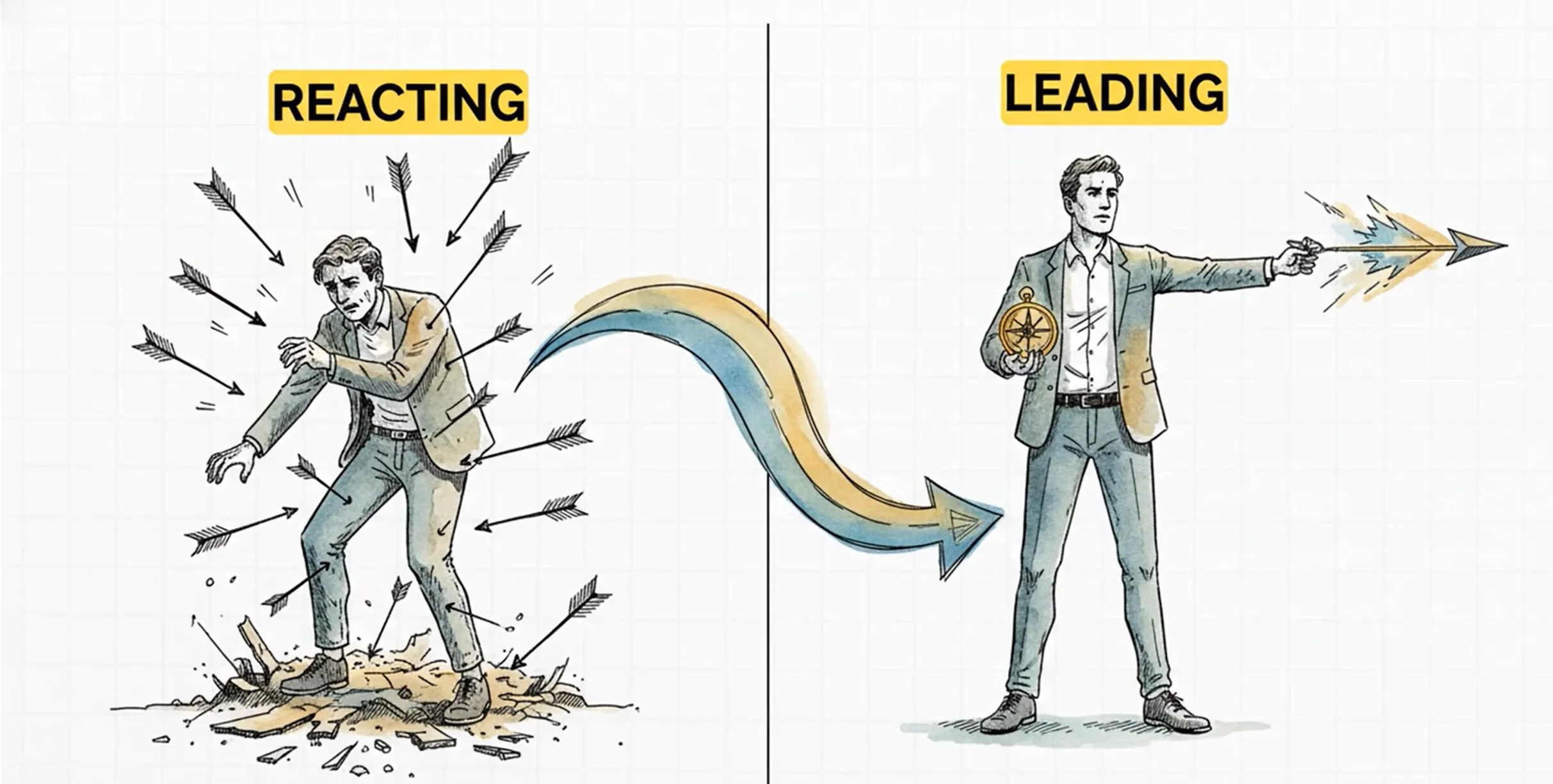
Operations Leaders: Stop Reporting Problems — Start Signaling Control

You run operations. Things break. Timelines slip. Vendors underperform. That’s the job.
But here’s what separates a director from a VP — and a VP from a C-suite operator:
It’s not whether you have problems. It’s the language you use to frame them.
When the board hears “we’re experiencing delays,” they hear risk. When they hear “we’re managing temporary throughput pressure,” they hear control.
Same facts. Completely different perception.
In the C-suite, credibility comes from three things:
- Stability — you’re not rattled
- Predictability — you see what’s coming
- Forward momentum — you’re already moving toward resolution
This lesson gives you 18 language upgrades that shift your reporting from operational noise to executive signal. These aren’t euphemisms — they’re precision. You’re not hiding problems. You’re communicating like someone who has them handled.
Part 1: From Neutral Status to Controlled, Forward Language
Goal: Keep facts intact while signaling stability and momentum.
The technique: Replace problem words with containment language. One word swap changes how the entire sentence lands.
Key upgrades to internalize:
| Instead of… | Say… |
|---|---|
| “experiencing" | "managing" |
| "issues" | "constraints" |
| "delays" | "temporary throughput pressure" |
| "shortage" | "capacity gap” |
Now practice. Read the “before” version out loud. Feel how reactive it sounds. Then read the upgrade — and hear the difference.
Drill 1
Before: We’re experiencing delays in the warehouse.
Executive version: We’re managing temporary throughput pressure in the warehouse.
“Experiencing delays” is passive — things are happening to you. “Managing throughput pressure” means you’ve diagnosed it, contained it, and you’re on it.
Drill 2
Before: There are issues with pick and pack accuracy.
Executive version: We’re addressing pick-and-pack accuracy constraints.
“Issues” is vague. “Constraints” implies a known boundary that can be engineered. “Addressing” tells the room you’re already working on it.
Drill 3
Before: Labor availability has been a problem.
Executive version: Labor availability remains constrained, but coverage is stable.
The second half does the heavy lifting. You named the constraint and immediately contained the risk. That’s what executives listen for.
Drill 4
Before: Outbound shipments are behind schedule.
Executive version: Outbound shipments are slightly behind plan, with recovery in progress.
“Behind schedule” sounds like a missed deadline. “Slightly behind plan, with recovery in progress” sounds like a controlled deviation with a path back.
Drill 5
Before: The 3PL isn’t performing well.
Executive version: 3PL performance is below expectation, and corrective actions are underway.
You didn’t complain about the vendor. You measured them against a standard, found them short, and initiated action. That’s a VP-level sentence.
Drill 6
Before: We’ve had staffing issues.
Executive version: Staffing levels are tight, but operational continuity is maintained.
When the C-suite hears “staffing issues,” they think fragility. When they hear “operational continuity is maintained,” they stop worrying — because you already answered the question they were about to ask.
Drill 7
Before: Order volume is causing problems.
Executive version: Order volume is creating manageable capacity pressure.
One word — “manageable” — changes the entire emotional register. You’ve acknowledged the pressure and contained it in the same breath.
Drill 8
Before: We’re struggling with fulfillment speed.
Executive version: Fulfillment speed is being actively optimized.
“Struggling” is emotional. “Actively optimized” is process language. The C-suite funds processes. They replace people who struggle.
Drill 9
Before: There’s a backlog.
Executive version: There is a controlled backlog with defined clearance timelines.
A backlog isn’t inherently bad — an uncontrolled one is. Adding “controlled” and “defined clearance timelines” turns a red flag into a status update.
Coaching Insight:
You’re not sugarcoating reality. You’re reporting it the way someone who has it handled would report it.
Part 2: From Pessimistic Framing to Operational Confidence
Goal: Acknowledge constraints while projecting resolution and oversight.
The technique: Name the issue without amplifying risk. The C-suite wants to know two things: What’s the situation? and Do you have it? Answer both in one sentence.
Key upgrades to internalize:
| Instead of… | Say… |
|---|---|
| “can’t" | "currently limited" |
| "failing" | "underperforming" |
| "out of control" | "under review" |
| "bad" | "outside tolerance” |
Drill 10
Before: We can’t keep up with demand.
Executive version: Current capacity is limited, but demand is being prioritized.
“Can’t” is a wall. “Currently limited” is a temporary state. “Being prioritized” means you’re triaging intelligently, not drowning.
Drill 11
Before: The vendor is failing to meet SLAs.
Executive version: The vendor is underperforming against SLAs.
“Failing” triggers alarm. “Underperforming” triggers review. Same gap — very different executive response.
Drill 12
Before: This process is out of control.
Executive version: This process is under review to improve consistency.
“Out of control” makes you sound like you’re watching it burn. “Under review” means you’ve already initiated governance. Night and day.
Drill 13
Before: Errors are getting worse.
Executive version: Error rates are trending outside tolerance.
“Getting worse” is subjective. “Trending outside tolerance” is measured. It implies you have a tolerance band, a tracking mechanism, and a threshold for action. You might — or you might not. But the language says you do.
Drill 14
Before: We’re behind on reporting.
Executive version: Reporting cadence is being re-stabilized.
“Behind” is backward-looking. “Re-stabilized” is forward-looking and implies a return to a known good state.
Drill 15
Before: Labor turnover is bad.
Executive version: Labor turnover remains elevated.
“Bad” is a judgment. “Elevated” is a measurement. Executives don’t judge — they calibrate.
Drill 16
Before: The system isn’t reliable.
Executive version: System reliability is below target.
“Below target” implies you have a target. It positions you as someone who measures outcomes, not someone who complains about tools.
Drill 17
Before: We don’t have visibility.
Executive version: Operational visibility is improving, with gaps identified.
You admitted the gap and claimed progress and showed specificity — all in one sentence. That’s three signals of control.
Drill 18
Before: Everything feels reactive.
Executive version: Operations are transitioning from reactive to controlled execution.
You took an emotional observation and turned it into a strategic narrative. You’re not stuck in reactive mode — you’re transitioning out of it. That word alone changes the story.
Coaching Insight:
The C-suite doesn’t promote people who report problems accurately. They promote people who report problems as managed situations.
Your Cheat Sheet: The Operations Control Vocabulary
Save this. Use it before every status update, board report, or executive sync.
| Reactive Word | Control Word |
|---|---|
| experiencing | managing |
| issues | constraints |
| delays | throughput pressure |
| shortage | capacity gap |
| can’t | currently limited |
| failing | underperforming |
| out of control | under review |
| bad | outside tolerance |
| struggling | optimizing |
| behind | re-stabilizing |
| problems | pressure points |
| don’t have | improving, with gaps identified |
How to Practice
- Before your next status update, scan your draft for any word in the left column. Replace it.
- Pick two drills per day. Say both versions out loud. Feel the difference in authority.
- Record yourself delivering a 60-second ops update using only control language. Play it back. That’s how the C-suite hears you.
Within two weeks, containment language becomes your default — and your executive presence changes permanently. These principles apply equally to email communication and video calls, where every word is amplified.
Ready to Sound Like You Belong in the Room?
These drills are a sample of what we build in executive coaching sessions. Every session is customized to your role, your industry, and the real situations you face — from board presentations to vendor negotiations to cross-functional status calls.
Book a free strategy session and we’ll identify exactly where your English is projecting control — and where it’s undermining your authority.
Keep Reading
- 14 Executive Reframing Drills — Precision language for leaders under pressure in any function
- The Executive Communication Playbook — The complete framework for executive presence in English
- How to Negotiate in English — The PREP framework for high-stakes conversations
- 4 Secrets Executives Use to Sound Confident — Master impromptu speaking with the PREP method