How to Lead a Meeting in English: 25 Phrases That Command Respect
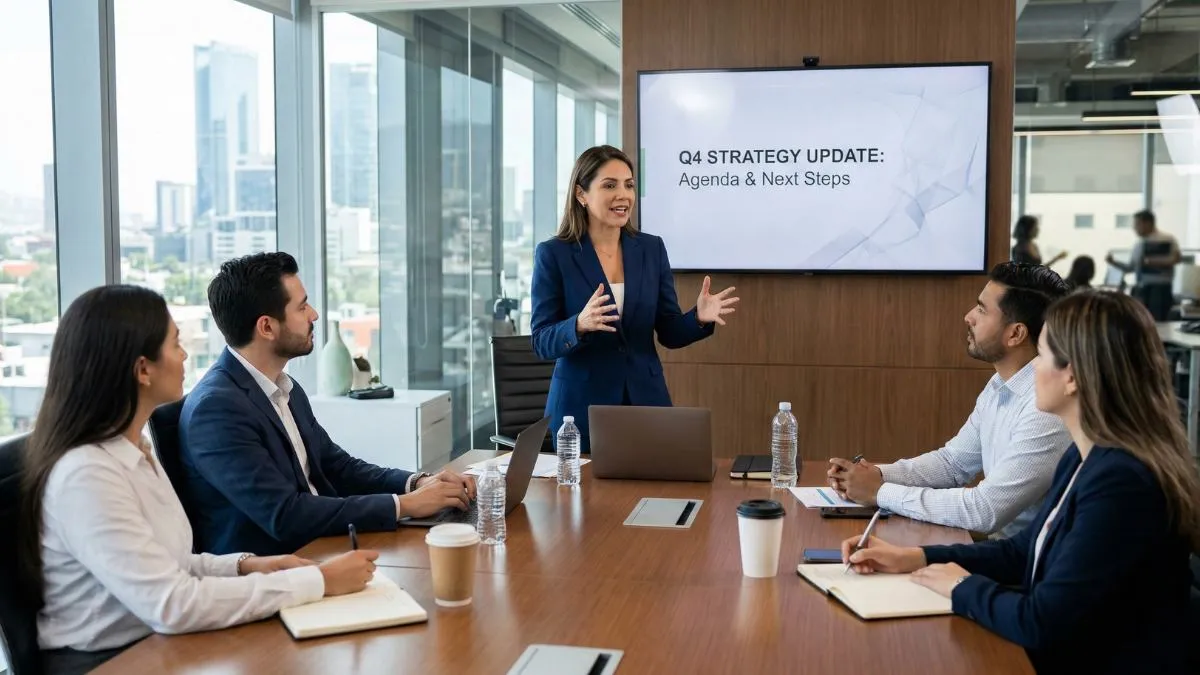
The Difference Between Attending a Meeting and Leading One
You attend meetings every week. You nod, contribute when asked, and follow the agenda someone else set.
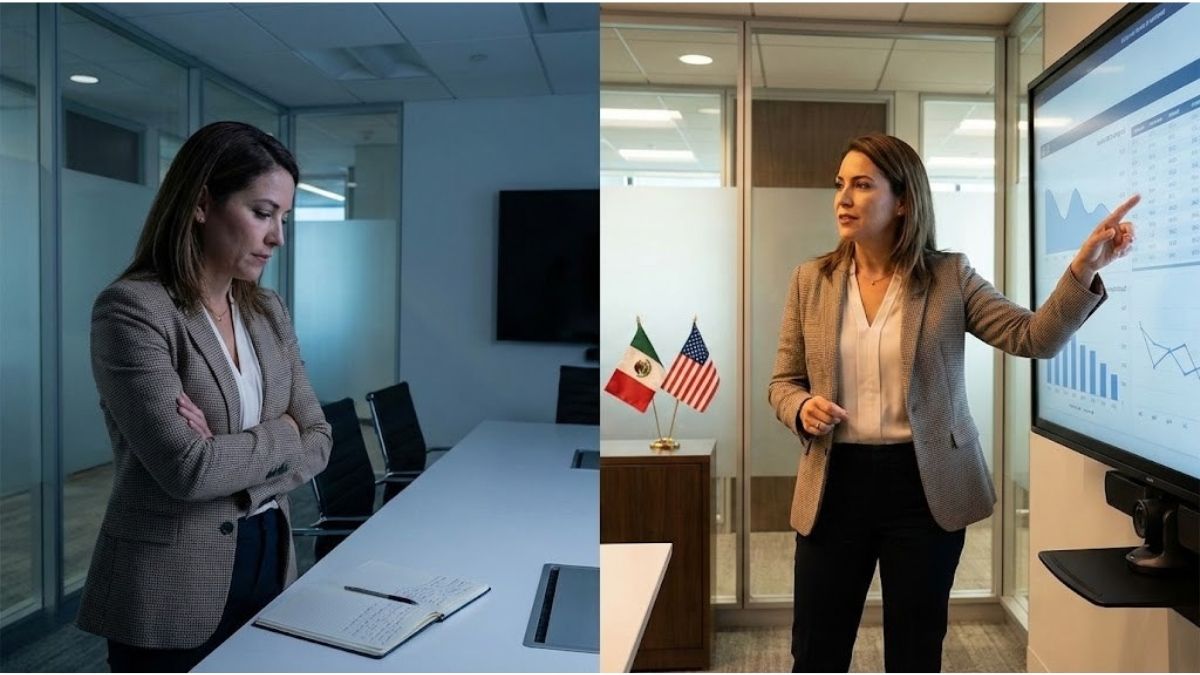
But leading a meeting in English—actually running the room, keeping people focused, handling the person who won’t stop talking, driving toward a decision—that requires a completely different set of language tools.
I’ve coached executives, directors, and senior managers across Latin America who are brilliant in Spanish boardrooms but feel like passengers the moment they have to chair a meeting in English. The problem is never their intelligence or their ideas. It’s that they don’t have the right phrases loaded and ready.
This post gives you those phrases. Twenty-five of them, organized across the five phases of every meeting. Memorize even half of these, and your team will notice the difference immediately.
The 5 Phases of Meeting Leadership
Every well-run meeting moves through five distinct phases. Most people only think about the middle—the discussion. But the leaders who command respect own the opening, manage the transitions, and close with precision.
Here’s your playbook.
Phase 1: Opening the Meeting
The first 90 seconds set the tone. If you open with confidence and clarity, people pay attention. If you fumble, you spend the rest of the hour trying to get it back.
Phrase 1: “Let’s get started. We have three items to cover, and I want to make sure we leave with clear next steps.”
When to use it: At the very start, especially when people are still chatting or settling in.
Why it works: It combines a polite but firm call to order with a preview of the agenda and a promise of structure. People immediately understand this meeting has a leader.
In context:
People are filtering in, side conversations happening. “All right, let’s get started. We have three items to cover, and I want to make sure we leave with clear next steps. First up: the Q2 timeline.”
Phrase 2: “Before we dive in, here’s what I’d like us to accomplish by the end of this meeting.”
When to use it: After the initial greeting, to frame the meeting around outcomes rather than topics.
Why it works: Most people announce topics. Leaders announce outcomes. This phrase signals that you’re results-oriented, and it gives the group a clear target to work toward.
In context:
“Thanks for joining, everyone. Before we dive in, here’s what I’d like us to accomplish by the end of this meeting: a final decision on the vendor, and alignment on the rollout timeline.”
Phrase 3: “I’ve shared the agenda ahead of time. Let me know if there’s anything you’d like to add before we proceed.”
When to use it: When you’ve sent a pre-read or agenda document and want to acknowledge it while maintaining control.
Why it works: It demonstrates preparation and invites input without surrendering ownership. You’re the host, and everyone knows it.
In context:
“I’ve shared the agenda ahead of time. Let me know if there’s anything you’d like to add before we proceed. No? Great—let’s start with item one.”
Phrase 4: “Just to set expectations, I’d like to keep this to 45 minutes so we can all get back to our priorities.”
When to use it: At the opening, especially for meetings that tend to run long.
Why it works: Respecting people’s time is one of the fastest ways to earn trust. This phrase tells the room you’re organized, efficient, and considerate—and it gives you permission to cut discussions short later.
In context:
“Just to set expectations, I’d like to keep this to 45 minutes so we can all get back to our priorities. That means we’ll need to stay focused—so I’ll jump in if we go off track.”
Phrase 5: “Let me provide a quick recap of where we left off last time, so everyone’s on the same page.”
When to use it: When the meeting is a continuation of a previous discussion, or when not everyone was in the last meeting.
Why it works: It eliminates the first five minutes of confusion where people try to remember what was decided. It also positions you as the person who owns the continuity of the project.
In context:
“Let me provide a quick recap of where we left off last time, so everyone’s on the same page. On Tuesday, we agreed to move forward with Option B pending legal review. Legal has since cleared it, so today we’re finalizing the timeline.”
Phase 2: Facilitating Discussion
This is where most meetings go sideways. People talk over each other, go off on tangents, or—worse—sit in silence. Your job is to draw the right people in, keep the conversation productive, and move things forward.
Phrase 6: “I’d like to hear from you on this, [Name]. What’s your perspective?”
When to use it: When a key stakeholder hasn’t spoken, or when you need a specific person’s input before moving forward.
Why it works: Calling someone by name is the single most effective facilitation technique. It shows you value their input, it prevents the loudest person from dominating, and it keeps everyone engaged because they know they might be called on next.
In context:
“We’ve heard a few perspectives. I’d like to hear from you on this, Maria. What’s your perspective from the engineering side?”
Phrase 7: “That’s a great point. How does that connect to the timeline we discussed?”
When to use it: When someone makes a valid point but the discussion is starting to drift.
Why it works: It validates the speaker (so they don’t feel shut down) while steering the conversation back to the agenda. It’s diplomatic redirection at its best.
In context:
“That’s a great point, Carlos. How does that connect to the timeline we discussed? I want to make sure we’re solving for the deadline while we explore this.”
Phrase 8: “Let’s pause on that for a moment. I want to make sure everyone has had a chance to weigh in.”
When to use it: When one or two people are dominating the conversation, or when a decision is being rushed.
Why it works: It slows the room down without blaming anyone. The word “pause” is powerful—it creates space without conflict. And “weigh in” is a natural business English phrase that signals you want diverse input.
In context:
“Let’s pause on that for a moment. I want to make sure everyone has had a chance to weigh in. Does anyone see a risk we haven’t discussed?”
Phrase 9: “I notice we’re getting into the details. Can we step back and confirm we agree on the overall approach first?”
When to use it: When the group jumps into execution details before aligning on strategy.
Why it works: This is a hallmark of strong leadership: the ability to zoom out when the room is zoomed in. It prevents wasted time and keeps decisions in the right order.
In context:
“I notice we’re getting into the details of the implementation. Can we step back and confirm we agree on the overall approach first? Once we’re aligned on the direction, we can map out the specifics.”
Phrase 10: “We have about 15 minutes left on this item. Let’s focus on what we need to decide today versus what can wait.”
When to use it: When time is running out and the group is still deep in discussion.
Why it works: It introduces urgency without panic. It also gives you a framework to park lower-priority items for later, which keeps the meeting on track.
In context:
“We have about 15 minutes left on this item. Let’s focus on what we need to decide today versus what can wait for next week’s sync.”
Phase 3: Handling Pushback
Disagreement in meetings is healthy—if you handle it well. The goal isn’t to avoid conflict. It’s to acknowledge it, manage it, and keep the meeting productive. These phrases let you disagree without damaging relationships.
Phrase 11: “I see it differently. Here’s my concern.”
When to use it: When you need to push back on someone’s proposal or opinion—especially someone senior.
Why it works: It’s direct without being aggressive. “I see it differently” is honest and respectful. Following it with “Here’s my concern” shifts the focus to the issue, not the person. This is executive-level communication at its most effective.
In context:
“I appreciate the rationale, and I see it differently. Here’s my concern: if we launch in Q2 without the integration, we risk losing the three enterprise clients who specifically requested it.”
Phrase 12: “I want to push back on that—not to be difficult, but because I think we’re missing something.”
When to use it: When you disagree with a direction the group seems to be heading, and you need to stop the momentum.
Why it works: The phrase “not to be difficult” pre-empts any perception that you’re being obstructive. It frames your pushback as constructive, which makes people more likely to listen. This is exactly the kind of high-stakes communication that separates good managers from great leaders.
In context:
“I want to push back on that—not to be difficult, but because I think we’re missing something. The data from last quarter suggests the opposite trend.”
Phrase 13: “That’s a valid point. And I think we also need to consider…”
When to use it: When you want to expand the conversation rather than directly contradict someone.
Why it works: “And” is far more powerful than “but” in disagreements. “But” erases everything before it. “And” adds to it. This phrase validates the other person while introducing your perspective as complementary rather than competing.
In context:
“That’s a valid point—the cost savings are significant. And I think we also need to consider the impact on the customer experience before we commit.”
Phrase 14: “Let’s separate the what from the how. I think we agree on the goal—we just differ on the approach.”
When to use it: When a disagreement is escalating and you need to find common ground.
Why it works: It reframes the conflict from “we disagree” to “we agree on the destination; we just need to negotiate the route.” This lowers tension immediately and opens the door to compromise.
In context:
“Let’s separate the what from the how. I think we agree on the goal—we want to reduce churn by 20%. We just differ on the approach. So let’s evaluate both options against the same criteria.”
Phrase 15: “I hear you. Let me repeat back what I’m hearing to make sure I understand before I respond.”
When to use it: When someone is frustrated or emotional, or when a miscommunication might be fueling the disagreement.
Why it works: Repeating someone’s position back to them is the most underrated leadership technique in business. It shows respect, buys you thinking time, and often reveals that the disagreement is smaller than it seemed. This is one of the strategies executives use to stay composed under pressure.
In context:
“I hear you. Let me repeat back what I’m hearing to make sure I understand before I respond. You’re saying the risk is too high to launch without a beta phase, and that two additional weeks would significantly reduce that risk. Is that right?”
Phase 4: Making Decisions
The whole point of most meetings is to reach a decision. Yet many meetings end with vague agreement and no clear commitment. These phrases ensure that decisions actually get made—and stick.
Phrase 16: “It sounds like we’re leaning toward Option A. Does anyone have a strong objection before we commit?”
When to use it: When the group has been discussing options and seems to be converging on one.
Why it works: “Leaning toward” reflects the room’s energy without prematurely closing the conversation. “Strong objection” is intentional—it raises the bar for dissent, which prevents minor quibbles from derailing the decision.
In context:
“It sounds like we’re leaning toward Option A—launching in Q3 with the reduced feature set. Does anyone have a strong objection before we commit?”
Phrase 17: “I’m going to make the call on this. Here’s what we’re going to do, and here’s why.”
When to use it: When discussion has gone on long enough and the group needs a decision from the leader.
Why it works: Sometimes consensus isn’t possible, and the leader needs to decide. This phrase is direct, accountable, and transparent. Explaining the “why” ensures buy-in even when people disagree.
In context:
“We’ve debated this thoroughly, and I appreciate everyone’s input. I’m going to make the call on this. Here’s what we’re going to do: we’re going with Vendor B. The reason is that their integration timeline aligns with our Q3 launch, and that’s our top priority.”
Phrase 18: “Let’s do a quick round. Thumbs up if you’re aligned, thumbs sideways if you have concerns we need to address.”
When to use it: When you need to quickly gauge alignment before finalizing a decision.
Why it works: It’s a lightweight consensus check that surfaces concerns without reopening the full debate. “Thumbs sideways” is less threatening than “thumbs down,” which encourages honest feedback.
In context:
“Before we lock this in, let’s do a quick round. Thumbs up if you’re aligned, thumbs sideways if you have concerns we need to address. I want to make sure we’re not leaving anything unresolved.”
Phrase 19: “We’re going in circles. Let me summarize the two options and we’ll decide.”
When to use it: When the group is stuck in a loop, rehashing the same arguments.
Why it works: Naming the pattern (“going in circles”) breaks it. Offering to summarize positions you as the leader who cuts through noise. And “we’ll decide” creates urgency and commitment.
In context:
“I think we’re going in circles on this. Let me summarize the two options. Option A gives us speed but less flexibility. Option B gives us flexibility but adds three weeks. Given our deadline, I’m recommending Option A. Can we agree on that?”
Phrase 20: “I want to make sure we’re not just agreeing to avoid conflict. Does anyone see a risk we haven’t named?”
When to use it: When the group agrees too quickly, which can signal groupthink.
Why it works: It creates psychological safety for dissent. By explicitly inviting concerns, you signal that speaking up is valued, not punished. This leads to better decisions—and prevents costly mistakes down the road.
In context:
“This seems straightforward, but I want to make sure we’re not just agreeing to avoid conflict. Does anyone see a risk we haven’t named? Now’s the time.”
Phase 5: Closing Strong
How you close a meeting determines whether anything actually happens afterward. A strong close turns discussion into action. A weak close turns it into another meeting.
Phrase 21: “Let me summarize what we decided and who owns what.”
When to use it: In the final five minutes of every meeting, without exception.
Why it works: This is the single most important phrase in meeting leadership. Summarizing decisions and assigning ownership eliminates ambiguity. People leave knowing exactly what they’re responsible for. If you only memorize one phrase from this list, make it this one.
In context:
“Let me summarize what we decided and who owns what. Decision one: we’re launching in Q3—Carlos is leading the rollout plan. Decision two: we’re going with Vendor B—Ana is handling the contract review. Decision three: the beta starts June 1—I’ll coordinate with engineering.”
Phrase 22: “I’ll send a follow-up email within the hour with action items and deadlines.”
When to use it: Immediately after summarizing decisions, to reinforce accountability.
Why it works: Verbal agreements fade. Written follow-ups don’t. Committing to a specific timeframe (“within the hour”) shows discipline and signals that you take the outcomes seriously. It also prevents the classic “I thought we decided something different” problem.
In context:
“I’ll send a follow-up email within the hour with action items and deadlines. If I’ve missed anything, reply to that email so we have it documented.”
Phrase 23: “Is there anything we discussed today that still feels unresolved?”
When to use it: Before officially closing, to catch lingering concerns.
Why it works: It’s a safety net. People often leave meetings with unanswered questions but don’t speak up because the meeting is “over.” This phrase gives permission to raise those issues and prevents them from becoming bigger problems later.
In context:
“Before we wrap up—is there anything we discussed today that still feels unresolved? I’d rather address it now than have it come back to us next week.”
Phrase 24: “Thank you for your time. I know everyone is busy, and I appreciate you being engaged.”
When to use it: As the final statement, especially after a long or contentious meeting.
Why it works: Gratitude is a leadership multiplier. Acknowledging people’s time and engagement builds goodwill and makes them more likely to show up prepared for the next meeting. It’s simple, and most people skip it.
In context:
“Thank you for your time. I know everyone is busy, and I appreciate you being engaged on this. We made real progress today.”
Phrase 25: “We’re ending five minutes early. You’re welcome.”
When to use it: When you’ve managed the meeting efficiently and can close before the scheduled end time.
Why it works: Ending early is the ultimate power move. It signals that you value efficiency, that you prepared well, and that you respect people’s time. The light humor of “You’re welcome” builds rapport. People will look forward to your meetings.
In context:
“That covers everything. We’re ending five minutes early. You’re welcome. See you all on Thursday.”
Virtual Meeting Bonus: 5 Tips for Zoom, Teams, and Meet
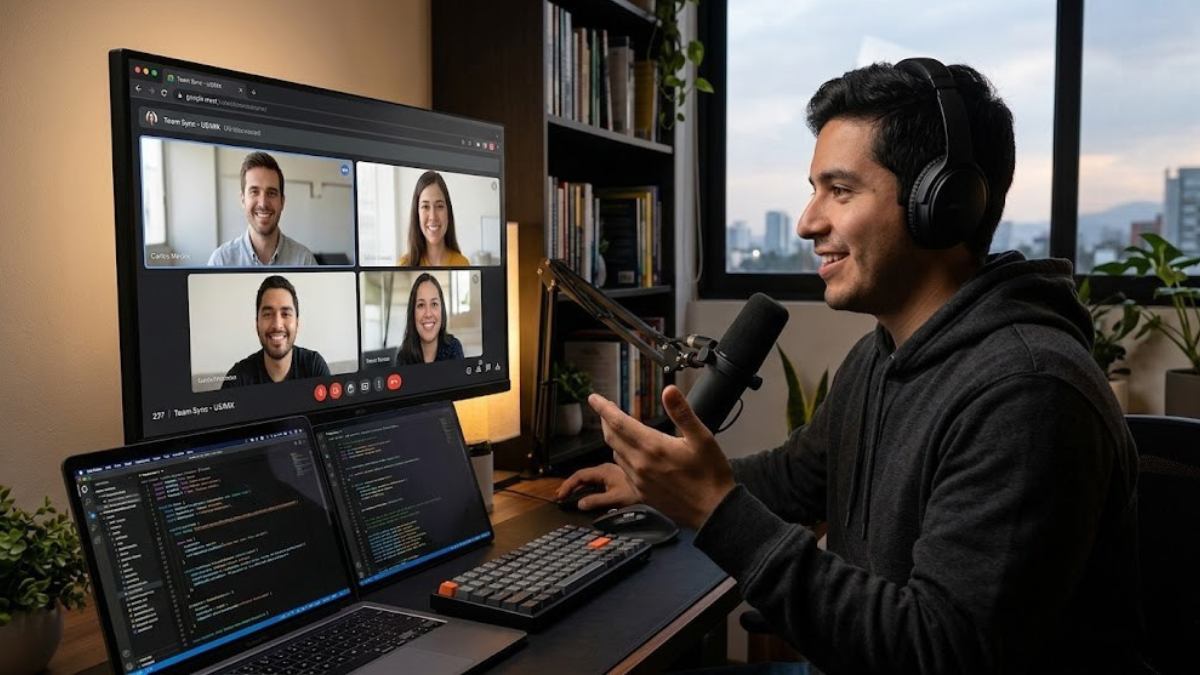
Leading a meeting is harder when you can’t read the room. Screens hide body language, mute buttons create silence, and connection issues test everyone’s patience. Here are five adjustments for virtual meetings.
1. Name People Before Asking
In person, you can make eye contact to invite someone to speak. On a video call, you have to say their name first—otherwise, nobody knows who you’re talking to.
Instead of: “What do you think?” Say: “Sofia, I’d like to hear your take on this.”
2. Use the Chat Strategically
Don’t let the chat become a side conversation that competes with you. Instead, own it.
“I’m going to drop the three options in the chat. Take 30 seconds to read them, and then we’ll discuss.”
3. Do a Verbal Roll Call on Decisions
You can’t see thumbs up reliably on video. Instead, call each person by name and ask for their position.
“Let me go around the room. Carlos, are you aligned? Maria? David?“
4. Acknowledge Technical Issues Gracefully
Freezing screens and dropped audio are inevitable. Handle them without losing momentum.
“It looks like we lost David for a moment. Let’s continue, and I’ll catch him up when he’s back.”
5. Close with Camera-On Energy
Virtual meetings tend to fizzle out. Make your closing deliberate—sit up, look at the camera, and deliver your summary with the same energy you’d use in a physical conference room.
“Okay, let me summarize where we landed today…” (camera on, direct eye contact, no multitasking)
Your Meeting Leadership Cheat Sheet
Want a printable reference with these 25 phrases plus additional rescue phrases for when meetings go sideways? Download the Meeting Rescue Phrases guide — it fits on one page and works for both in-person and virtual meetings.
Stop Surviving Meetings. Start Leading Them.
Here’s the truth: meeting leadership is a skill, not a personality trait. You don’t need to be the loudest person in the room. You don’t need perfect English. You need the right phrases at the right moments, delivered with calm authority.
The 25 phrases in this post will cover 90% of the situations you’ll encounter. Practice them. Internalize them. And start using them in your next meeting.
If you want to go deeper—if you want to practice running meetings in English with real-time coaching, role-play difficult facilitation scenarios, and build the kind of executive presence that changes how people perceive you—book a free strategy session and let’s work on it together.
Your next meeting is your next opportunity. Lead it.