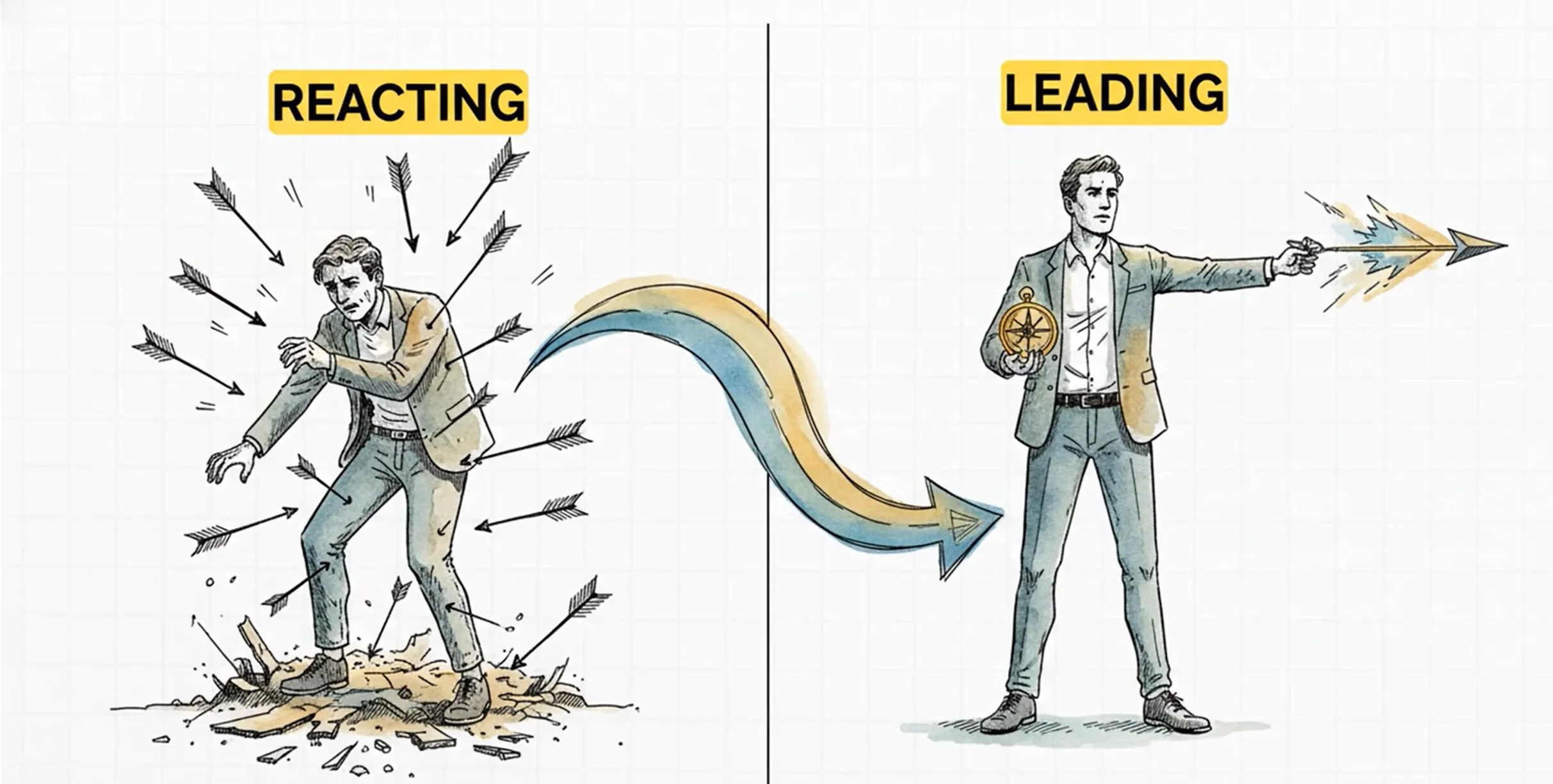
14 Executive Reframing Drills That Make You Sound Like a Leader

You’re not here to “learn English.”
You’re here to engineer perception.
The difference between a mid-level manager and a C-suite executive isn’t vocabulary. It’s precision under pressure — the ability to replace vague, emotional, reactive language with structured authority in real time.
These 14 drills are designed to rewire your instincts. Read the weak version. Then read — and listen to — the executive version. Say it out loud. No hesitation.
Click the speaker icon to hear each phrase spoken with proper executive pacing and tone.
Part 1: Precision Language Drills (Executive Reframing Under Pressure)
Goal: Eliminate vague, emotional, or reactive phrasing in real time.
Instructions: Upgrade each sentence instantly. Speak it out loud. No hesitation.
Drill 1
You hear yourself say: “This is getting out of control.”
Upgrade it to: This is deviating from our operating structure.
Notice the shift — you’re not reacting. You’re diagnosing.
Drill 2
You hear yourself say: “We’re losing money here.”
Upgrade it to: The current structure is eroding margin.
“Losing money” is panic. “Eroding margin” is analysis.
Drill 3
You hear yourself say: “This vendor is difficult.”
Upgrade it to: The vendor relationship lacks alignment on expectations.
You’re not complaining. You’re identifying the gap.
Drill 4
You hear yourself say: “We need to fix this quickly.”
Upgrade it to: We need a controlled resolution with clear ownership.
Speed without structure is chaos. Leaders add structure.
Drill 5
You hear yourself say: “This doesn’t make sense.”
Upgrade it to: I’m not seeing the commercial logic yet.
“Yet” does the heavy lifting. It keeps the door open while signaling that the burden of proof is on them.
Drill 6
You hear yourself say: “They’re asking for too much.”
Upgrade it to: The request exceeds the value exchange.
You’ve just reframed an emotional reaction into a negotiation position.
Drill 7
You hear yourself say: “This deal could blow up.”
Upgrade it to: This deal carries execution risk we haven’t mitigated.
“Blow up” is fear. “Execution risk we haven’t mitigated” is a board-ready observation.
Coaching Insight:
You are not “speaking English.” You are engineering perception.
Part 2: Interruption & Control Drills (Meeting Power Dynamics)
Goal: Maintain authority without aggression.
Instructions: Respond calmly, in one sentence. No emotional tone.
Drill 8
Situation: Someone cuts you off mid-sentence.
Your response: I’ll complete the point — then I want your input.
You acknowledge them. You don’t yield.
Drill 9
Situation: Two directors start arguing loudly.
Your response: Let’s anchor this in decision criteria.
One sentence. The argument is now a process. You own the room.
Drill 10
Situation: Someone dismisses your idea quickly.
Your response: Walk me through your assumption.
You didn’t defend. You put them on the spot — respectfully.
Drill 11
Situation: A senior leader pushes urgency without clarity.
Your response: I’m aligned on speed — I need clarity on constraints.
You’re not saying no. You’re saying “give me what I need to move fast.”
Drill 12
Situation: A rep keeps talking in circles.
Your response: Let’s distill this to the key decision.
You just saved 15 minutes and everyone in the room knows it.
Drill 13
Situation: You’re being challenged publicly.
Your response: That’s a fair challenge — here’s how I’m framing it.
“Fair challenge” disarms. “Here’s how I’m framing it” reestablishes authority.
Drill 14
Situation: Silence in the room after your question.
Your response: I’ll give you a second — this requires precision.
You didn’t fill the silence with weakness. You upgraded it to weight.
Coaching Insight:
Control is not volume. Control is structure + pacing.
How to Practice These Drills
- Read the weak version out loud. Feel how it lands.
- Click the speaker icon on the executive version. Listen to the pacing.
- Repeat it out loud — match the tone and rhythm.
- Use one drill per day in a real meeting or conversation.
This isn’t memorization. It’s muscle memory. Within two weeks, these patterns become your default — especially powerful when combined with the 7 habits that build trust on video calls.
Ready to Go Deeper?
These drills are a sample of what we build in executive coaching sessions. Every session is customized to your role, your industry, and the real situations you face.
Book a free strategy session and we’ll identify exactly where your English is helping you — and where it’s holding you back.
Keep Reading
- The Executive Communication Playbook — The complete framework for executive presence in English
- 4 Secrets Executives Use to Sound Confident — The PREP method for impromptu speaking
- How to Lead a Meeting in English — Phrases and frameworks for running high-stakes meetings