The Executive Communication Playbook: How Senior Leaders Command Influence in English
You’re brilliant in your native language.
In Spanish, Portuguese, or French, you command the room. You read people. You persuade, negotiate, pivot mid-conversation, and close deals with confidence that comes from decades of experience.
Then you switch to English—and something changes.
The words come slower. Your sentences get shorter. You hedge when you should assert. You agree when you should push back. You react when you should lead.
And the worst part? The people on the other end of that call—your clients, your board, your US counterparts—don’t see the leader you actually are. They see someone who seems uncertain, junior, or disengaged.
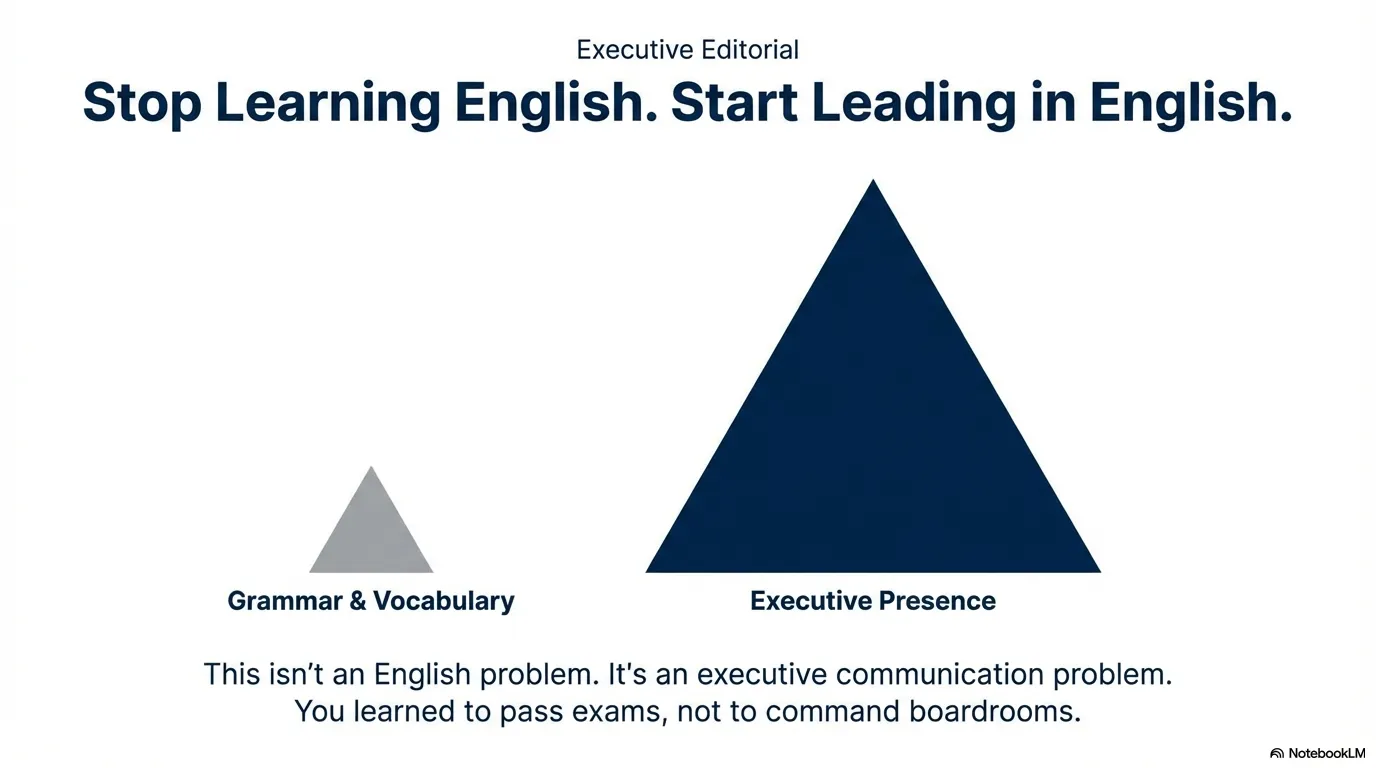
This isn’t an English problem. It’s an executive communication problem.
Nobody taught you the executive communication style in English. You learned grammar. You learned vocabulary. Maybe you even scored well on a proficiency test. But scoring well on an exam and commanding a boardroom are entirely different skills.
This playbook covers the 7 pillars that separate “fluent speakers” from leaders who command influence in English. These are the exact frameworks I use with C-suite executives, VPs, startup founders, and senior technical leaders across Latin America—and they work across every industry and every high-stakes situation.
Pillar 1: Leadership Language — Stop Reacting, Start Leading
The single biggest communication gap I see with senior professionals isn’t vocabulary or grammar—it’s reactivity.
When something goes wrong, most non-native speakers default to reactive language: reporting the problem, explaining what happened, and waiting for someone else to set the direction. In their native language, they’d already be three steps ahead. In English, the cognitive load of translating slows them down just enough that they fall into a defensive pattern.
Here’s what reactive vs. leadership language sounds like in practice:
Reactive (how most people report):
“There’s a problem with the shipment. The carrier didn’t pick up on time and the client is upset.”
Leadership (what executives actually say):
“We’ve identified a delay in the carrier pickup. We’ve already escalated with the logistics partner, the client has been notified with an updated timeline, and I’ll have a confirmed resolution by 3 PM.”
The difference isn’t about using fancier words. It’s about answering three questions in every statement:
- What happened? (Brief, factual—don’t dramatize)
- What are you doing about it? (Show you’re already in motion)
- When will they know more? (Give a specific commitment)
This structure works everywhere—operations updates, incident reports, client calls, board meetings. It signals that you’re in control, not just aware of the problem.
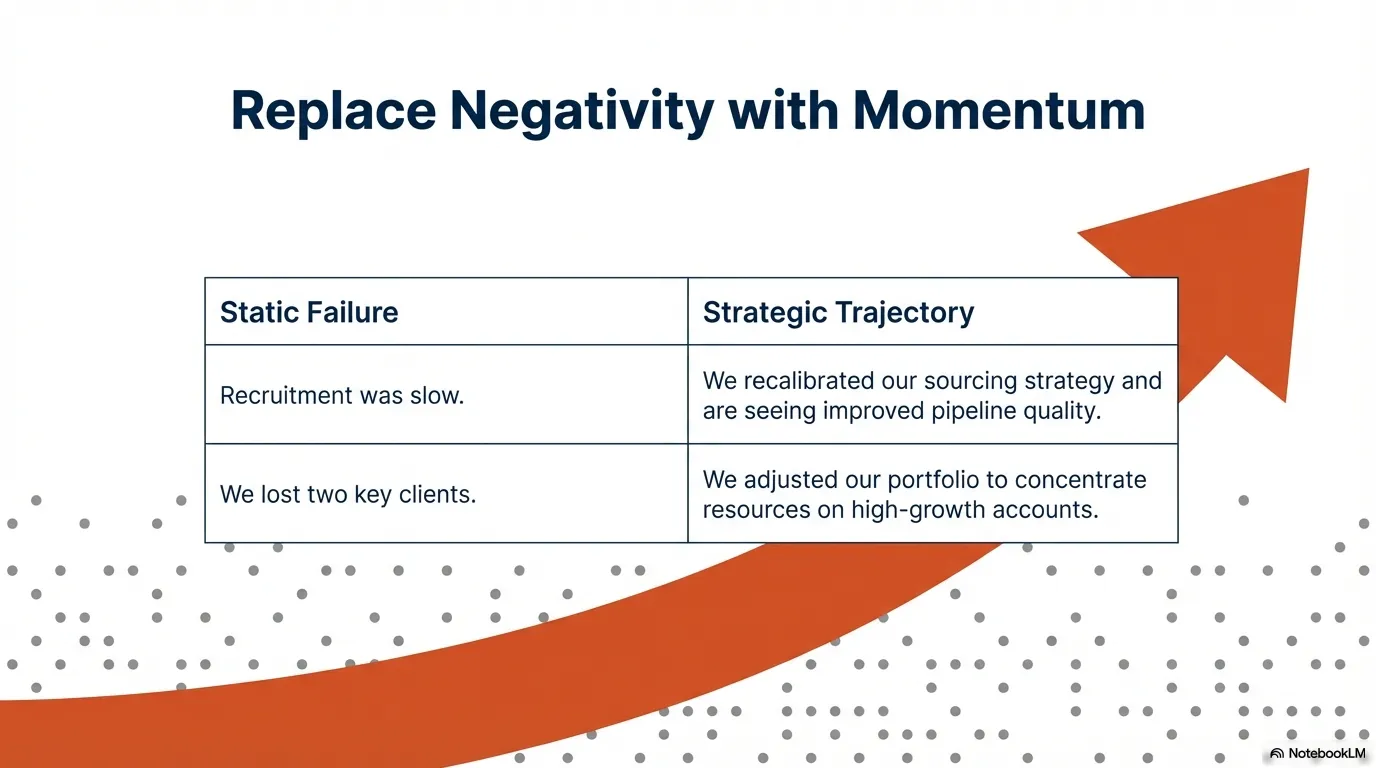
Trajectory Language: Replace Negativity with Momentum
Another pattern I coach is what I call trajectory language—replacing static, negative descriptions with language that implies direction and forward motion.
Instead of:
“Recruitment was slow last quarter.”
Try:
“Recruitment volume moderated as we recalibrated our sourcing strategy. We’re already seeing improved pipeline quality this month.”
Instead of:
“We lost two key clients.”
Try:
“We experienced some portfolio adjustment, which has actually allowed us to concentrate resources on our highest-growth accounts.”
This isn’t spin or corporate doublespeak. It’s a genuine shift in framing—from reporting what went wrong to communicating what’s actually happening strategically. Senior leaders in English-speaking business culture do this instinctively. When you learn to do it consciously, you immediately sound more senior.
Practice this: Take your last three status updates or reports. Rewrite every negative statement using trajectory language. Notice how the entire tone shifts from defensive to strategic.
Pillar 2: The Art of Persuasion — Vision Over Urgency
Most professionals make requests that sound like problems:
“We need more budget.” “We don’t have enough people for this project.” “The timeline is too aggressive.”
These are factually accurate—but they position you as the person raising obstacles, not the person driving solutions. In English-speaking executive culture, the people who get what they want frame every request as a strategic opportunity.
Problem framing (what most people say):
“We need to hire three more engineers or we won’t meet the deadline.”
Vision framing (what gets budget approved):
“With a strategic investment in three additional engineers, we can accelerate delivery by six weeks and capture the Q3 market window. The ROI on that acceleration is approximately 4x the hiring cost.”
The structure behind vision framing is:
- Name the investment (not the cost)
- Connect it to a business outcome (not your problem)
- Quantify the upside (make it concrete)
Diagnose the System, Not the People
When you need to raise concerns or push back, great communicators frame issues as systemic, not personal. Compare:
“The marketing team isn’t delivering leads fast enough.”
With:
“There’s a gap between our pipeline velocity targets and our current lead generation capacity. I’d like to propose a cross-functional sprint to close that gap.”
The first version creates enemies. The second creates alignment. Both describe the same situation, but one positions you as a leader and the other positions you as a complainer.
This distinction matters enormously in cross-cultural business. Latin American executives often worry about sounding too direct or aggressive in English. The solution isn’t to soften everything—it’s to redirect the directness toward systems and processes rather than people.
Key persuasion phrases to master:
- “What I’m proposing is…”
- “The strategic case for this is…”
- “If we invest in X, we unlock Y…”
- “This positions us to…”
- “The opportunity cost of not acting is…”
Test Your Knowledge: Pillars 1 & 2
How well did you absorb the leadership language and persuasion frameworks? Flip each card to check your understanding.
Pillar 3: Strategic Negotiation — Firm Without Friction
Negotiation in English is where most non-native speakers feel the biggest gap. You know your value. You know your position. But in the moment, under pressure, in your second language, you either:
- Over-concede — agreeing to terms you’d never accept in your native language because finding the right pushback phrases feels impossible in real time
- Over-correct — coming across as blunt or aggressive because you’re translating directly from your native communication style
Neither works. What works is learning the specific English patterns that let you be firm without creating friction.
The Warm Boundary Framework
The best negotiators in English defend their positions while preserving warmth. Here’s the structure:
- Acknowledge their position (shows you’re listening)
- Bridge to your position (don’t say “but”—say “and” or “at the same time”)
- Offer an alternative that works for both sides
Example:
“I appreciate the offer, and I understand the budget constraints on your end. At the same time, the scope we’ve outlined requires a level of investment that reflects its strategic value. What I’d propose is a phased approach—we start with the highest-impact deliverable at the current budget, and we revisit scope expansion once we’ve demonstrated ROI.”
Notice what this does: it doesn’t say “no.” It doesn’t fight. It repositions the conversation from price to value and offers a path forward. This is the kind of language that closes deals rather than stalling them.
The Concession Trap
Here’s a costly mistake I see constantly: using weak language in negotiation creates expensive precedents.
When you say things like:
“I guess we could probably do that…” “Maybe we could make it work…” “I suppose that’s okay…”
You’re signaling that your position isn’t firm—and the other side will push harder next time. Every “I guess” costs you money, timeline, or scope in future negotiations.
Strong alternatives:
- “That’s something I can commit to.” (clear yes)
- “That’s outside what I can accommodate in this scope.” (clear no)
- “Here’s what I can do…” (redirecting)
Ready to assess your negotiation communication? Take the Communication Confidence Quiz to see where you stand.
Pillar 4: Executive Storytelling — From Data Dump to Narrative
Every executive meeting has two types of presenters: those who share information and those who tell a story. The information-sharers get polite nods. The storytellers get their proposals approved.
The problem isn’t that non-native speakers lack data or insight—it’s that under the cognitive load of presenting in English, they default to listing facts instead of building a narrative. The result is a “data dump” that’s accurate but forgettable.
The Narrative Spine
Every executive communication—whether it’s a 30-second elevator pitch or a 30-minute board presentation—should follow this structure:
- Context — What’s the situation? (One sentence)
- Recommendation — What should we do? (Lead with the answer)
- Reasons — Why this approach? (Three supporting points maximum)
- Next step — What happens now? (Specific, time-bound)
Data dump version:
“So we looked at the Q4 numbers and revenue was down 8% versus plan. The main drivers were lower volume in the enterprise segment, a delayed product launch that pushed two deals to Q1, and seasonal effects. We also saw higher churn in the SMB segment. We’re working on some initiatives to address this…”
Narrative version:
“We ended Q4 at 92% of plan—and I want to walk you through why I’m actually optimistic about that number. The 8% gap was driven by two specific, fixable factors: two enterprise deals worth $340K that slipped to Q1 due to our product launch timing, and seasonal churn patterns we’ve now modeled. My recommendation: we pull forward the Q1 launch by two weeks, which recovers both deals and sets us up for a record Q1. I’ll have the revised timeline to you by Friday.”
Same data. Completely different impact. The second version:
- Leads with confidence, not apology
- Explains the “why” behind the numbers
- Offers a specific recommendation
- Ends with a commitment
The Quotability Test
The best communicators create phrases that other people reuse. After your next presentation or meeting, ask yourself: Is there a single phrase someone might repeat to their team?
If not, your message wasn’t sharp enough. Great executive communication is quotable—it gives people language they can carry forward.
Pillar 5: Impromptu Speaking — Thriving Off-Script
High-stakes presentations are stressful enough. But the moment most executives fear isn’t the prepared portion—it’s the Q&A. When the slides end and someone asks an unexpected question, that’s when your real English shows.
Non-native speakers often panic in these moments because they lose the safety net of preparation. But here’s the truth: leaders love unscripted moments. Q&A is where trust is built, where your expertise shines, and where you differentiate yourself from people who can only perform when they’ve rehearsed.
The PREP Method for Impromptu Responses
When hit with an unexpected question, use this framework:
- Point — State your answer immediately (don’t build up to it)
- Reason — Give one supporting reason
- Example — Provide a brief, concrete example
- Point — Restate your answer (bookend it)
Example question: “Do you think AI will replace project managers?”
PREP response:
“No, I don’t think AI will replace project managers—it will amplify them. (Point) The core value of a PM is navigating ambiguity and aligning people, which requires judgment that AI can’t replicate. (Reason) For example, on our last product launch, the critical decisions were about stakeholder trade-offs and team morale—things no algorithm could have managed. (Example) So AI is a powerful tool for PMs, but it’s the human judgment layer that creates the real value. (Point)”
This entire response takes about 20 seconds. It sounds thoughtful, structured, and confident—even if you assembled it in real time.
Building Impromptu Fluency
The way to get comfortable with unscripted English isn’t more vocabulary—it’s more reps. In my coaching sessions, we practice:
- Opinion drills: “What do you think about X?” with 30 seconds to respond using PREP
- Challenge rounds: I push back on your answer and you defend it live
- Pivot practice: Redirecting a hostile or off-topic question to your key message
The goal isn’t scripted perfection. It’s comfortable imperfection—the ability to think and speak simultaneously in English without freezing.
Pillar 6: Empathetic Communication — Trust Before Solutions
Here’s a pattern I see in almost every logistics manager, tech leader, and operations executive I coach: when a client or team member has a problem, they jump straight to the solution.
In their mind, they’re being helpful and efficient. But to the person on the other end, it feels dismissive—like their frustration doesn’t matter, only the fix does.
The best leaders in English-speaking business culture do something counterintuitive: they slow down before they speed up. They validate the emotion before presenting the data.
The AOAC Empathy Framework
- Acknowledge — Name what they’re feeling (don’t dismiss it)
- Own — Take appropriate responsibility (don’t deflect)
- Act — Describe what you’re doing (be specific)
- Commit — Give a concrete next step with a timeline
Without empathy (efficient but cold):
“The shipment was delayed because of a carrier issue. It’ll arrive Thursday.”
With AOAC (efficient and human):
“I understand this delay is frustrating, especially with your production schedule on the line. (Acknowledge) This is on us—we should have flagged the carrier risk earlier. (Own) We’ve already rerouted through an express partner and I’m personally tracking this shipment. (Act) You’ll have confirmed delivery by Thursday noon, and I’ll send you tracking updates every 6 hours until then. (Commit)”
The second version takes 15 more seconds to say. But it transforms a frustrated client into a loyal one. It signals that you’re not just competent—you’re someone who gets it.
Why This Matters More in English
In many Latin American business cultures, empathy is communicated implicitly—through tone, body language, and relationship context. But in English-language business (especially with US clients and colleagues), empathy needs to be verbalized. If you don’t say it, they don’t feel it.
This is one of the most impactful shifts my clients make: learning to explicitly acknowledge emotions in English before moving to solutions. It’s uncomfortable at first (it can feel performative), but once you see how dramatically it changes the response you get from clients and colleagues, it becomes second nature.
Pillar 7: Precision and Presence — The Details That Signal Authority
The first six pillars are about what you say. This pillar is about how you say it—the subtle signals that tell listeners whether you’re a junior professional or a senior leader.
Pronunciation Precision
This isn’t about eliminating your accent—your accent is part of your identity and most native English speakers don’t care about accents. What they do notice is whether you’re precise or sloppy with key sounds.
The sounds that matter most for executive presence:
- Consonant clusters at the end of words: “risks” (not “ris”), “tasks” (not “tas”), “products” (not “produc”)
- Diphthongs in high-frequency words: the difference between “focus” and “foe-cus,” between “growth” and “groth”
- Word stress in professional vocabulary: it’s “de-VEL-op-ment” not “dev-e-LOP-ment,” “a-NAL-y-sis” not “an-a-LY-sis”
These small precision points don’t make or break comprehension—but they signal competence. A leader who pronounces “stakeholders” crisply sounds more authoritative than one who mumbles through it, regardless of accent.
Connector Phrases That Signal Structure
Senior communicators use verbal signposts that guide listeners through their reasoning. These are the phrases that make you sound organized and in command:
For sequencing:
- “Let me walk you through three things…”
- “The first consideration is… The second is… And finally…”
- “Before I get to the recommendation, here’s the context…”
For pivoting:
- “That’s an important point. Let me build on that…”
- “I want to zoom out for a moment…”
- “Let me reframe this slightly…”
For landing key points:
- “The bottom line is…”
- “If you take away one thing from this…”
- “Here’s what this means for us specifically…”
These phrases buy you thinking time while making you sound more, not less, in control.
Tense and Vocabulary Choices That Signal Seniority
Junior professionals describe. Senior professionals direct. Compare:
| Junior | Senior |
|---|---|
| ”I think we should maybe consider…" | "My recommendation is…" |
| "We had some problems with…" | "We navigated a challenge around…" |
| "It’s kind of complicated because…" | "The complexity here is…" |
| "I was wondering if we could…" | "What I’d propose is…" |
| "Sorry, but I disagree…" | "I see it differently, and here’s why…” |
Every word choice is a signal. When you consistently choose language that projects clarity and direction, people unconsciously assign you more authority—regardless of your accent, your title, or your first language.

What’s Next: From Reading to Doing
Understanding these 7 pillars is the first step. But reading about executive communication and doing it under pressure are two very different things. The real transformation happens when you practice these frameworks in realistic scenarios—negotiations with pushback, board presentations with tough Q&A, client calls where emotions run high.
Assess Where You Stand
Not sure which pillars are your strengths and which need work? Take the Executive Communication Confidence Quiz—it takes 5 minutes and gives you a personalized breakdown of your communication profile across all 7 areas.
Go Deeper on Specific Skills
Explore the pillar that resonates most:
- Negotiation skills → How to Negotiate in English When It’s Not Your First Language
- Email communication → Email Phrases That Make You Sound Junior (And What to Say Instead)
- Presentation confidence → How to Own the Room on Executive Video Calls
- Quick wins → 5 Practical Ways to Boost Your Business English Today
Ready to Work on This?
If you’re a senior professional who’s tired of being underestimated in English, let’s talk. I work with executives, founders, and technical leaders across Latin America who are ready to close the gap between their expertise and how they communicate it.
Book a free strategy call and we’ll map out exactly which pillars will have the biggest impact on your career.
This isn’t about learning English. It’s about learning to lead in English.