English for Customs & Cross-Border Freight
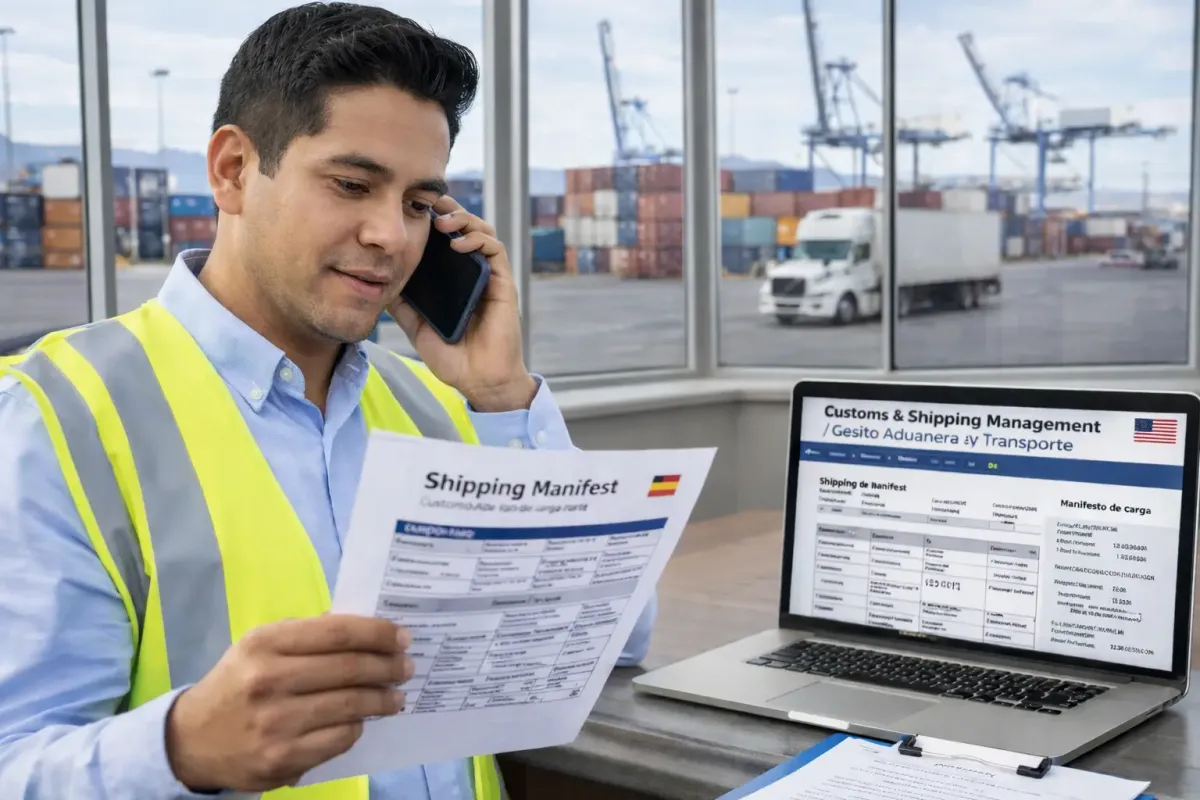
The Nearshoring Boom Created a Language Problem
Mexico is having a moment. Since 2023, nearshoring has transformed the country into the United States’ number one trading partner. Billions of dollars in goods cross the border every day through Laredo, El Paso, Nogales, and Otay Mesa.
But here’s what nobody talks about at the trade conferences: the professionals managing these shipments are hitting a language wall every single day.
I coach logistics coordinators, customs brokers, and freight managers across Guadalajara, Monterrey, and Mexico City. The pattern is always the same. They know their job inside and out in Spanish. They can navigate SAT requirements, coordinate with Mexican carriers, and manage warehouse operations without breaking a sweat. But the moment they need to call a US freight broker about a delayed shipment, email a client about a customs hold, or negotiate rates with an American 3PL—everything slows down.
The problem isn’t their English level. Most of these professionals have intermediate English. The problem is that customs and freight English is its own language, full of abbreviations, industry jargon, and communication patterns that no general English course covers.
This post gives you the specific vocabulary, phrases, and communication templates you need to operate confidently across the US-Mexico border. Whether you’re coordinating cross-border freight under USMCA (T-MEC) or managing customs clearance documentation, these are the words and phrases that matter.
Why General English Courses Fail Logistics Professionals
Let me illustrate the gap. A logistics coordinator I work with in Monterrey has a B2 certificate. She can discuss politics, describe travel experiences, and write formal emails. But when she needed to tell a broker in Dallas that a shipment was on customs hold because of an HTS code discrepancy, she froze.
She knew the situation perfectly in Spanish. But she didn’t have the English vocabulary for customs and freight shipping loaded and ready. So she sent a vague email that said “there is a problem with the shipment at the border” and spent three days going back and forth instead of resolving it in one phone call.
This is the gap I see constantly. It’s the same gap that costs Mexican companies millions in lost deals and delayed operations—not because people lack competence, but because they lack the specific language tools for their industry.
General English courses teach you to order at a restaurant. What you need is to explain to a US customs broker why your Certificate of Origin shows a different HS code than the commercial invoice—and to do it clearly, in 90 seconds, on a phone call with bad reception.
Let’s build that toolkit.
50 Essential English Terms for Customs and Cross-Border Freight
This glossary covers the terms you’ll encounter daily when working with US freight brokers, customs officials, and American clients. I’ve organized them by category so you can study the ones most relevant to your role.
Customs and Border Terms
| English Term | Spanish Equivalent | Usage Note |
|---|---|---|
| Customs clearance | Despacho aduanero | ”The shipment is pending customs clearance at Laredo.” |
| Customs broker | Agente aduanal | US-side broker who files entry documents |
| Entry summary (CBP 7501) | Pedimento (equivalente EE.UU.) | The primary US customs document |
| HTS code (Harmonized Tariff Schedule) | Fracción arancelaria | Must match between invoice and entry |
| Duty | Arancel / impuesto de importación | ”What’s the duty rate on this HTS code?” |
| Anti-dumping duty (ADD) | Cuota compensatoria | Extra duties on specific products or countries |
| Countervailing duty (CVD) | Cuota compensatoria | Similar to ADD; targets subsidized imports |
| Customs hold | Retención aduanera | ”Our shipment is on customs hold.” |
| Customs exam | Revisión / inspección aduanera | Physical or X-ray inspection at port of entry |
| Port of entry (POE) | Puerto de entrada | Laredo, El Paso, Nogales |
| In-bond shipment | Tránsito aduanero (en EE.UU.) | Goods moving under bond to another US port |
| Bonded warehouse | Almacén fiscal (equivalente EE.UU.) | Storage without paying duties immediately |
| Free Trade Zone (FTZ) | Zona franca | Duty-deferred areas within the US |
| Country of origin | País de origen | Critical for USMCA qualification |
| Certificate of Origin | Certificado de origen | Required for USMCA preferential tariff |
Shipping Documents
| English Term | Spanish Equivalent | Usage Note |
|---|---|---|
| Bill of Lading (BOL / B/L) | Conocimiento de embarque | ”Please send the BOL for tracking.” |
| Commercial invoice | Factura comercial | Must match the packing list exactly |
| Packing list | Lista de empaque | Itemized contents of each package or pallet |
| Proof of delivery (POD) | Comprobante de entrega | ”We need the signed POD from the consignee.” |
| Shipper’s Letter of Instruction (SLI) | Instrucciones del embarcador | Tells the forwarder how to handle shipment |
| Arrival notice | Aviso de arribo | Notification that cargo has arrived at port |
| Freight bill | Factura de flete | Invoice for transportation charges |
| Customs power of attorney | Poder aduanal | Authorizes the broker to act on your behalf |
| USMCA/T-MEC certification | Certificación T-MEC | Proves goods qualify for preferential treatment |
| IMMEX certificate | Certificado IMMEX | Mexico’s maquiladora export program documentation |
Freight and Logistics Operations
| English Term | Spanish Equivalent | Usage Note |
|---|---|---|
| Full truckload (FTL) | Camión completo | ”We need an FTL from Monterrey to Dallas.” |
| Less than truckload (LTL) | Carga consolidada | Shared truck space |
| Drayage | Acarreo local | Short-haul transport, usually port to warehouse |
| Cross-dock | Cross-dock / transbordo directo | Transfer without storage |
| Transload | Transbordo / transferencia de carga | Moving cargo between containers or trailers |
| Carrier | Transportista | The company physically moving the freight |
| Freight forwarder | Agente de carga / freight forwarder | Arranges transportation on behalf of shipper |
| 3PL (third-party logistics) | 3PL / operador logístico | Outsourced logistics provider |
| Consignee | Consignatario / destinatario | The party receiving the goods |
| Shipper / consignor | Embarcador / remitente | The party sending the goods |
| ETA (estimated time of arrival) | Hora estimada de llegada | ”What’s the ETA at the Laredo crossing?” |
| Lead time | Tiempo de entrega | Total time from order to delivery |
| Demurrage | Demoras / sobrestadía | Charges for keeping a container past free time |
| Detention | Detención | Charges for keeping a trailer past free time |
| Accessorial charges | Cargos adicionales | Extra fees like liftgate or inside delivery |
Incoterms in Context
| Incoterm | What It Means in Practice | Common Usage |
|---|---|---|
| EXW (Ex Works) | Buyer handles everything from seller’s facility | ”The price is EXW Guadalajara.” |
| FCA (Free Carrier) | Seller delivers to a named carrier/place | ”FCA Monterrey, carrier picks up at our plant.” |
| FOB (Free on Board) | Risk transfers when goods are loaded | Most common for US-Mexico trade |
| CIF (Cost, Insurance, Freight) | Seller pays freight and insurance to destination | More common in ocean freight |
| DDP (Delivered Duty Paid) | Seller handles everything including duties | ”The quote is DDP Houston warehouse.” |
| DAP (Delivered at Place) | Seller delivers to destination, buyer clears customs | ”DAP Laredo, buyer handles US customs.” |
Phrases for Calling a US Freight Broker
Phone calls are where most logistics professionals struggle the most. You can’t pause to look up a word. You can’t edit what you just said. And US freight brokers talk fast—they’re managing dozens of shipments and don’t have time for unclear communication.
Here’s a structure that works every time. This approach to confident, structured communication applies whether you’re on the phone with a broker or presenting to a client.
Opening the Call
Instead of: “Hello, I am calling because we have a problem with a shipment…”
Say: “Hi, this is [Name] from [Company] in [City]. I’m calling about shipment [reference number]. Do you have a minute?”
Why it works: You’ve identified yourself, your company, the specific shipment, and asked for their time—all in 10 seconds. The broker immediately knows what file to pull up.
Requesting a Rate Quote
“I need a rate quote for an FTL from Monterrey to Dallas. It’s 22 pallets, approximately 38,000 pounds. Standard dry van. We need it picked up by Thursday. Can you give me a spot rate?”
Key vocabulary in action: FTL, pallets, dry van, spot rate. No filler, no over-explaining.
Reporting a Shipment Issue
“I’m calling to flag an issue on BOL number [X]. The driver arrived at the pickup, but the load isn’t ready. We’re looking at a two-hour delay minimum. I wanted to give you a heads-up before it impacts the delivery window.”
Why it works: You stated the problem, the document reference, the impact, and the reason for the call. The broker can act on this immediately.
Asking About Customs Status
“Can you check the status on entry number [X]? It crossed at Laredo yesterday, and we haven’t received the release notification yet. Is it on hold, or is it just processing?”
Key phrase: “Is it on hold, or is it just processing?” — this shows you understand the difference and saves the broker from over-explaining.
Negotiating Rates
“That rate is higher than what we’ve been paying on this lane. We’ve been running two to three loads a week on Monterrey-Dallas for the last six months. Can you sharpen that number?”
Key phrase: “Can you sharpen that number?” — this is natural broker English for “Can you lower the price?” It’s direct without being aggressive.
Email Templates for Common Freight Situations
Email is more forgiving than phone calls—you can draft, revise, and verify terminology. But many logistics professionals still send emails that are either too vague or too formal. Here are templates that hit the right professional tone. If you recognize some of these patterns from your own inbox, you’re not alone—email tone mistakes are among the most common issues I see across industries.
Notifying a Client About a Shipment Delay
Subject: Shipment [reference] — Delay Update
Hi [Name],
I wanted to update you on shipment [reference number]. The load was scheduled to cross at Laredo today, but it’s currently on a customs hold pending document review.
Here’s what we know:
- Issue: CBP flagged a discrepancy between the HTS code on the commercial invoice and the entry summary.
- Action taken: Our customs broker is filing a corrected entry. We expect clearance within 24-48 hours.
- Revised ETA: [Date], assuming clearance by tomorrow.
I’ll send another update once we have the release confirmation. Let me know if you have any questions.
Best regards, [Name]
Why it works: Specific problem, specific action, revised timeline, and a commitment to follow up. No vague “there’s been a delay” without context.
Requesting a Missing Document
Subject: Missing BOL — Shipment [reference]
Hi [Name],
We’re processing shipment [reference] and noticed we’re missing the signed Bill of Lading. Could you send it over by end of day? We can’t file the entry summary without it.
If there’s an issue with the BOL, let me know and we’ll work out an alternative.
Thanks, [Name]
Escalating a Cargo Damage Claim
Subject: Cargo Damage Claim — Shipment [reference]
Hi [Name],
We received shipment [reference] at our warehouse today and found damage to [number] pallets. I’ve attached photos and a copy of the signed POD noting the damage.
Here’s the breakdown:
- Damaged items: [description]
- Estimated value: $[amount] USD
- POD notation: Driver acknowledged damage at delivery
Please open a claim and let us know the next steps. We need to resolve this before we can release the goods to the end customer.
Regards, [Name]
Customs Clearance Communication
Clearing goods through US Customs and Border Protection (CBP) involves a specific communication flow. Whether you’re working with your US customs broker or communicating directly with CBP, here are the phrases that matter.
Common Customs Hold Scenarios and How to Communicate About Them
Scenario 1: HTS Code Discrepancy
“CBP flagged a mismatch between the HTS code on our commercial invoice and the entry summary. The invoice shows 8471.30.01, but the broker filed under 8471.41.01. We need to file a corrected entry.”
Scenario 2: Missing Certificate of Origin
“The shipment qualifies for USMCA preferential treatment, but we didn’t include the Certificate of Origin with the entry documents. Can you file a post-entry claim? We have the certification ready to submit.”
Scenario 3: FDA or USDA Hold
“The shipment is on an FDA hold at the port of entry. They’re requesting lab analysis on the product before release. We’re coordinating with the manufacturer to get the test results. Expected turnaround is 48 to 72 hours.”
USMCA / T-MEC Specific Language
Since USMCA (known as T-MEC in Mexico) governs most US-Mexico trade, you need these phrases:
- “This shipment qualifies for USMCA preferential tariff treatment under the rules of origin.”
- “The regional value content meets the transaction value method threshold.”
- “We can provide the USMCA certification of origin. It’s a self-certification—we don’t need a government stamp.”
- “The product undergoes a tariff shift from Chapter 39 to Chapter 94, which satisfies the product-specific rule.”
Common mistake I hear: Mexican professionals often say “T-MEC” in English conversations. US brokers and customs officials almost always say “USMCA.” Using the US terminology shows you’re adapting to your audience—a small detail that builds credibility.
Before/After: Common Mistakes and How to Fix Them
These are real communication patterns I’ve corrected with my logistics coaching clients. The “before” versions are things I hear regularly.
Mistake 1: Vague Problem Reporting
Before: “Hello, there is a problem with the merchandise at the border. Please help.”
After: “Hi, our shipment under entry number 123-4567890 is on a customs hold at Laredo. CBP is requesting an amended commercial invoice because the declared value doesn’t match the purchase order. Can you file the amendment today?”
The fix: Specific reference number, specific port, specific problem, specific request.
Mistake 2: Translating Literally from Spanish
Before: “We need to make the customs dispatch of the merchandise.” (despacho aduanero translated literally)
After: “We need to clear the shipment through customs.”
The fix: “Customs clearance” or “clear through customs”—not “customs dispatch.” This is one of those direct translation traps that instantly marks you as a non-native speaker.
Mistake 3: Overusing “Please” to the Point of Passivity
Before: “Could you please be so kind as to provide us with the information regarding the status of the shipment at your earliest convenience, please?”
After: “Can you send me a status update on this shipment by end of day?”
The fix: One “please” or “can you” is sufficient. Stacking polite phrases makes you sound uncertain—and in freight, uncertainty slows everything down.
Mistake 4: Confusing Key Terms
Before: “We need to pay the demurrage because the trailer stayed too long.” (using demurrage when they mean detention)
After: “We’re facing detention charges because the trailer was held at the warehouse beyond the free time.”
The fix: Demurrage applies to containers (usually ocean freight). Detention applies to trailers and chassis. US brokers will correct you on this, and it undermines your credibility.
Mistake 5: Missing the USMCA Terminology
Before: “The product has the free trade agreement benefit.”
After: “The product qualifies for preferential tariff treatment under USMCA. We have the certification of origin ready.”
The fix: Specific treaty name, specific benefit (preferential tariff treatment), and confirmation that documentation is available.
The Nearshoring Advantage—If You Have the Language
Here’s the bigger picture. Mexico’s nearshoring boom has created unprecedented demand for logistics professionals who can operate bilingually across the border. According to the American Chamber of Commerce in Mexico (AmCham), nearshoring-related investment commitments exceeded $50 billion in 2024-2025, and a significant percentage of that involves cross-border supply chains that require daily English communication.
The professionals who can communicate fluently with US freight brokers, customs brokers, and supply chain managers are commanding premium salaries and career advancement. The ones who can’t are being passed over—not because they lack logistics expertise, but because their English creates friction in operations that need to move fast.
If you’re a customs coordinator, freight manager, or logistics executive working in cross-border trade, your English isn’t a nice-to-have anymore. It’s a core operational competency.
Your Next Step
If you recognized yourself in the “before” examples above, here’s what I’d recommend:
-
Start with the glossary. Print the 50-term table and highlight the terms you use most often. Practice saying them out loud—pronunciation matters when you’re on the phone with a US broker.
-
Rewrite your last three freight emails in English. Use the templates above as a guide. Are you being specific enough? Are you using the right terminology?
-
Record yourself explaining a customs hold scenario. Play it back. Can a US broker understand the problem in under 30 seconds?
-
Take the Speaking Confidence Quiz to identify where your communication gaps are holding you back.
-
Explore Logistics English Coaching if you want structured training built specifically for cross-border freight and customs professionals. I work with logistics teams across Mexico on exactly these scenarios—phone calls with US brokers, customs documentation communication, and rate negotiations.
The cargo knows how to cross the border. The question is whether your English can keep up with it.
Keep Reading
- The Real Cost of Weak English: Lost Deals, Blocked Promotions — The business case for investing in English, with real numbers from Mexican companies navigating international trade.
- 10 Business English Mistakes Mexican Professionals Make — Common Spanish-to-English interference patterns that undermine your credibility with US counterparts.
- Email Phrases That Make You Sound Junior — Fix the email habits that make US brokers and clients take you less seriously.
Robert Cushman is an English communication coach based in Guadalajara who works with logistics professionals, customs brokers, and freight managers across Mexico. He specializes in the specific English patterns required for cross-border operations—not textbook grammar, but the real language of international trade.