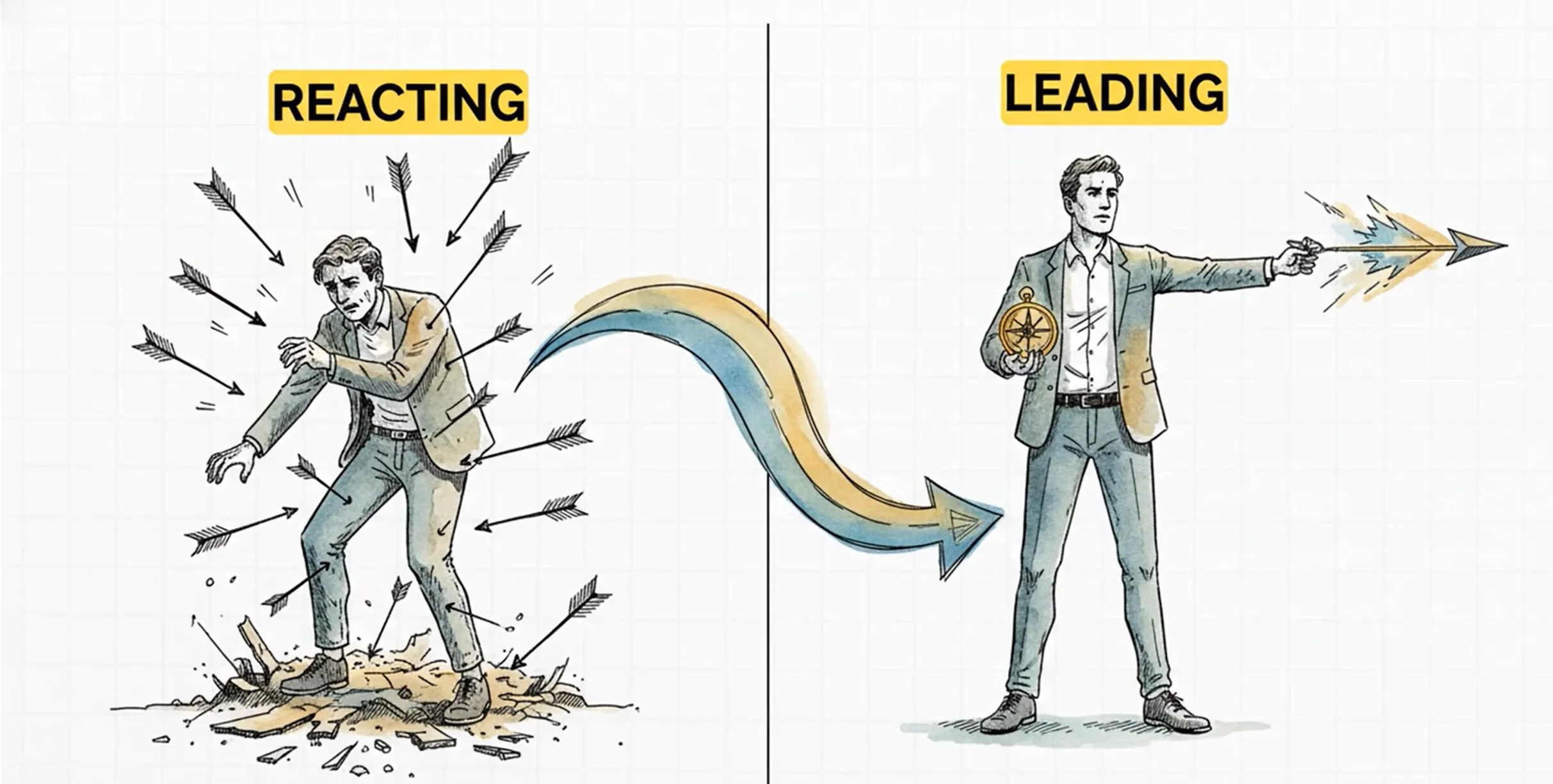
The COO's 30-Second Rule: How Operations Leaders Respond Under Pressure

You’re in a leadership meeting. The CEO turns to you and says:
“Why are we missing delivery targets?”
You have 30 seconds. Maybe less.
What comes out of your mouth in that moment — not what you know, not what you planned to say — determines whether the room sees a COO or a middle manager.
Most operations leaders default to one of two failure modes under pressure: vague optimism (“We’re working on it”) or emotional honesty (“We’re overwhelmed right now”). Both destroy credibility instantly.
The executives who command rooms don’t have better answers. They have better frameworks — mental structures that activate under pressure and produce controlled, strategic responses every time.
This article gives you those frameworks. First, we’ll upgrade the reactive language that’s undermining your authority in status updates. Then we’ll put you through 9 real-world pressure scenarios with 30-second executive response models.
If you’ve already worked through our operations control language drills or the executive reframing system, this is where those patterns get tested under fire.
The Foundation: Upgrading Reactive Language
Before you can perform under pressure, you need to eliminate the reactive vocabulary that surfaces when stress hits. These are the phrases that slip out automatically — and each one signals to the C-suite that you’re reacting, not leading.
Here are the critical upgrades. Say the “before” version out loud. Then say the upgrade. Feel the difference in authority.
Status Language
Before: “We have a lot of problems in the warehouse.”
Upgrade: “Warehouse operations are experiencing multiple constraints, with stabilization in progress.”
The pattern: “[Area] is experiencing [measured noun], with [action] in progress.” You named it, contained it, and showed forward motion — in one sentence.
Before: “Orders are getting delayed.”
Upgrade: “Order fulfillment is operating below target, with recovery actions underway.”
“Getting delayed” is passive — things are happening to you. “Operating below target” means you measured the gap. “Recovery actions underway” means you’re already moving.
Before: “We’re overwhelmed right now.”
Upgrade: “Operations are managing a temporary volume surge, while maintaining execution continuity.”
“Overwhelmed” is emotional. “Managing a temporary volume surge” is operational. The word “temporary” does the heavy lifting — it tells the room this has a shelf life.
Risk & Performance Language
Before: “This supplier is unreliable.”
Upgrade: “Supplier performance is below reliability targets, with corrective measures being implemented.”
You didn’t complain about the vendor. You measured them against a standard, found them short, and initiated corrective action. That’s a VP-level sentence.
Before: “This is getting worse.”
Upgrade: “Performance is trending outside acceptable tolerance, with risk exposure increasing.”
The pattern: “trending outside tolerance” — this implies you have tolerance bands, tracking mechanisms, and thresholds. Whether you do or not, the language says you do.
Decision & Resource Justification
When you need resources, budget, or time, the C-suite doesn’t respond to complaints. They respond to risk reduction and ROI.
Before: “We need more staff.”
Upgrade: “Additional staffing would reduce throughput risk during peak demand and improve execution stability.”
You connected headcount to throughput risk and execution stability. That’s a business case in one sentence, not a request for help.
Before: “We should change vendors.”
Upgrade: “A vendor transition would improve reliability, reduce risk exposure, and strengthen SLA performance.”
Three measurable outcomes in one sentence. The C-suite doesn’t approve changes — they approve improvements to metrics they care about.
Coaching Insight:
These upgrades aren’t about sounding impressive. They’re about training your brain to reach for control language under stress instead of reactive language. When you practice these enough, the upgraded version becomes your default — and your executive presence changes permanently.
The 30-Second Framework: Performing Under Pressure
Now we move from vocabulary to execution. The following scenarios simulate real leadership moments where you’re put on the spot with no preparation time.
The structure you need to internalize:
- Frame the situation — What’s actually happening (not how it feels)
- Diagnose the real issue — The root cause, not the symptom
- Introduce a decision — Your recommendation
- Sequence the action — What happens first, then what follows
- Connect to outcome — Why this approach works
You don’t need all five in every response. But the best COO responses hit at least three.
Part 1: Executive Alignment Under Pressure
These scenarios test your ability to align teams, reduce noise, and create direction when things are chaotic.
Scenario 1: Misaligned Priorities
The situation: You’re in a leadership meeting. Sales is pushing aggressive growth, but operations is struggling to keep up. Leadership wants clarity immediately.
The prompt: Align the team and define direction. You have 30 seconds.
What most people say: “I think we just need to communicate better and try to align everyone.”
That’s not a response. That’s a hope.
What a COO says:
“We’re seeing competing priorities between growth and operational capacity, which is creating execution friction. The immediate focus needs to be alignment on a single objective for the next 30 days. My recommendation is we prioritize operational stability while supporting controlled growth. This allows us to stabilize execution before scaling further. Once capacity is consistent, we can increase volume without increasing risk.”
Why this works: You framed the conflict (competing priorities), diagnosed the root issue (capacity vs. growth), introduced a decision (prioritize stability), and sequenced the path forward (stabilize, then scale). That’s executive thinking — not reaction.
The reusable pattern:
- “We’re seeing…”
- “The immediate focus needs to be…”
- “My recommendation is…”
- “This allows us to…”
Scenario 2: Too Many Initiatives
The situation: Your team is overloaded with campaigns, product launches, and operational fixes. Execution is inconsistent.
The prompt: Refocus the team. 30 seconds.
What most people say: “We just have too much going on right now.”
What a COO says:
“The issue isn’t effort — it’s prioritization. We’re currently running too many parallel initiatives, which is reducing execution quality. The priority now is to focus on the top three outcomes that directly impact performance. Everything else needs to be paused or sequenced. This will restore consistency and allow us to deliver predictably.”
Why this works: You reframed the problem (not effort — prioritization), simplified complexity, forced a decision, and connected it to a measurable outcome (consistency).
The reusable pattern:
- “The issue isn’t X — it’s Y”
- “The priority now is…”
- “Everything else needs to…”
Scenario 3: Cross-Team Misalignment
The situation: Warehouse, logistics, and customer service are not coordinated. Delays and confusion are increasing.
The prompt: Fix coordination. 30 seconds.
What most people say: “Teams need to communicate better.”
What a COO says:
“This is a coordination gap, not a capability issue. Each team is working, but they are not aligned in execution. We need a shared operating rhythm with clear timelines, defined handoffs, and aligned priorities. I’ll implement that structure so execution becomes consistent across functions. This will eliminate delays and improve overall performance.”
Why this works: You removed blame, diagnosed a system failure instead of a people failure, introduced structure, and took personal ownership. The C-suite funds people who build systems — not people who blame teams.
The reusable pattern:
- “This is not X — it’s Y”
- “We need…”
- “I’ll implement…”
Part 2: Performance & Accountability
These scenarios test your ability to hold standards while maintaining authority and trust. This is where many operations leaders in their second language default to either being too soft (losing authority) or too aggressive (losing trust).
Scenario 4: Missed Deadlines
The situation: A manager consistently delivers late. It’s impacting the team.
The prompt: Address performance directly. 30 seconds.
What most people say: “You need to be more responsible with deadlines.”
What a COO says:
“We agreed on clear timelines, but recent deliverables have not met expectations. The standard at this level is predictable execution. Right now, the gap is in follow-through and early visibility. Going forward, I need earlier escalation if something is at risk. We’ll also implement a weekly checkpoint to ensure consistency.”
Why this works: You defined the standard clearly, identified the gap precisely, removed emotion entirely, and introduced a system for improvement. You’re not criticizing — you’re calibrating.
The reusable pattern:
- “The standard is…”
- “The gap is…”
- “Going forward…”
Scenario 5: Low Quality Work
The situation: Work requires constant rework and slows execution.
The prompt: Correct the issue professionally. 30 seconds.
What most people say: “This isn’t good enough.”
What a COO says:
“I’ve reviewed the recent output, and the quality is below the expected standard. The expectation is work that moves forward without rework. The current gap is in detail and completeness. We need to clearly define what ‘done’ looks like before execution begins. I also want a review step in place before submission.”
Why this works: You removed emotional language, defined expectations clearly, identified the root issue (no shared definition of “done”), and installed a corrective system. This is management through structure, not frustration.
The reusable pattern:
- “The expectation is…”
- “The current gap is…”
- “We need to…”
Scenario 6: Lack of Ownership
The situation: A team member avoids responsibility and waits for direction.
The prompt: Raise expectations. 30 seconds.
What most people say: “You need to take more ownership.”
What a COO says:
“I’m noticing hesitation in taking ownership of outcomes. At this level, the expectation is proactive responsibility, not just task execution. The gap is in identifying issues early and acting on them. Going forward, I expect you to surface risks and propose solutions before escalation. This will improve both speed and accountability.”
Why this works: You redefined the role expectation, identified the specific behavior gap, and set a forward standard. You’re not complaining about attitude — you’re recalibrating performance.
The reusable pattern:
- “At this level…”
- “The expectation is…”
- “I expect you to…”
Part 3: Strategic Decision & Executive Presence
These are the highest-stakes moments — where you speak as a C-level operator defending strategy, justifying investment, and managing crisis with control.
Scenario 7: Growth vs. Capacity
The situation: Demand is increasing rapidly, but operations are under pressure.
The prompt: Explain your strategy. 30 seconds.
What most people say: “We’re getting overwhelmed with demand.”
What a COO says:
“We’re seeing strong demand growth, but capacity is approaching its limits. The risk is service degradation if we continue at this pace without adjustment. My recommendation is a phased capacity expansion to support growth while maintaining stability. This allows us to scale without compromising execution quality. We need to balance speed with control.”
Why this works: You translated emotion into strategy. You defined the risk clearly (service degradation), provided a structured solution (phased expansion), and balanced competing priorities (speed vs. control). This is how COOs think out loud.
The reusable pattern:
- “We’re seeing…”
- “The risk is…”
- “My recommendation is…”
Scenario 8: Budget Pushback
The situation: Finance challenges your budget request.
The prompt: Defend your investment. 30 seconds.
What most people say: “We really need this budget.”
What a COO says:
“I understand the need for cost discipline. This investment directly reduces operational risk and protects revenue. Without it, we increase exposure to delays and service instability. This is not additional cost — it’s a targeted investment in performance and predictability. The return is improved reliability and reduced disruption.”
Why this works: You acknowledged the finance perspective first (shows cross-functional awareness), reframed cost as investment, and connected it to risk reduction and revenue protection. You didn’t ask for money — you made a business case.
The reusable pattern:
- “I understand…”
- “This investment…”
- “Without it…”
Scenario 9: Supplier Failure
The situation: A supplier delay is impacting production.
The prompt: Respond and show control. 30 seconds.
What most people say: “The supplier failed and caused delays.”
What a COO says:
“The issue is reliability, not just delay. The risk is repeated disruption to production if this continues. In the short term, we are stabilizing supply to protect delivery commitments. In parallel, we are introducing redundancy to reduce future exposure. We will also reinforce performance expectations with the current supplier.”
Why this works: You removed blame, reframed from incident to system risk, split your response into short-term and long-term actions, and showed governance. The C-suite didn’t hear excuses — they heard a COO managing a supply chain.
The reusable pattern:
- “The issue is…”
- “In the short term…”
- “In parallel…”
Your Cheat Sheet: The 30-Second Response Patterns
Save these. Practice one per day until they fire automatically.
For Alignment & Direction
| Pattern | Use When… |
|---|---|
| ”We’re seeing… The immediate focus needs to be…” | Competing priorities need resolution |
| ”The issue isn’t X — it’s Y” | You need to reframe a problem |
| ”This is not X — it’s Y. I’ll implement…” | Blame needs to become structure |
For Accountability
| Pattern | Use When… |
|---|---|
| ”The standard is… The gap is… Going forward…” | Addressing underperformance |
| ”The expectation is… We need to…” | Setting quality standards |
| ”At this level… I expect you to…” | Raising ownership expectations |
For Strategic Decisions
| Pattern | Use When… |
|---|---|
| ”We’re seeing… The risk is… My recommendation is…” | Presenting strategy under pressure |
| ”I understand… This investment… Without it…” | Defending budget or resources |
| ”The issue is… In the short term… In parallel…” | Managing crisis with control |
How to Practice
- Pick one scenario per day. Set a 30-second timer on your phone. Answer out loud. No preparation.
- Record yourself. Play it back. Listen for filler words, hedging, and emotional language. Replace them.
- Use the patterns as scaffolding. Start by following the exact structure. Once it’s automatic, make it your own.
- Practice the pronunciation. These words trip up Spanish speakers under pressure: stabilization, prioritization, accountability, predictability, degradation, reliability. Say each one slowly, then at natural speed, then confidently.
Within two weeks, these patterns become muscle memory. You stop thinking about what to say and start thinking about how to lead — which is the entire point.
These frameworks complement the operations control vocabulary for status updates and the executive reframing drills for real-time language upgrades. Together, they form a complete system for executive presence in operations leadership.
Ready to Perform Under Pressure — In English?
These scenarios are a sample of what we build in executive coaching sessions. Every session is customized to your role, your industry, and the real pressure moments you face — from board presentations to budget defense to cross-functional alignment calls.
Book a free strategy session and we’ll run a live 30-second pressure drill. You’ll hear exactly where your English is projecting control — and where it’s costing you authority.
Keep Reading
- Operations Leaders: Stop Reporting Problems — Start Signaling Control — 18 language upgrades for operational status updates
- 14 Executive Reframing Drills — Precision language for leaders under pressure in any function
- How to Negotiate in English — The 5-step framework for high-stakes conversations
- Why You Struggle to Speak English in Meetings — The real reason fluent professionals freeze under pressure